

Traditional Japanese Makeup Guide: From Oshiroi to Geisha & Kabuki Styles
In the West, makeup is often about enhancing features or concealing imperfections. But in Japan, specifically within the realm of traditional Japanese makeup, cosmetic application is far more than a beauty routine—it is a discipline, a cultural identity, and a form of performance art that has survived for centuries. When you see the stark white face of a Geisha or the dramatic red lines of a Kabuki actor, you aren’t just looking at paint on skin; you are witnessing a living history book.
This art form, rooted in the Heian and Edo periods, tells stories of status, maturity, and emotion without speaking a single word. While most people recognize the iconic white face, few understand the intricate rules governing oshiroi (white powder), beni (red pigment), and ohaguro (blackened teeth). It is a world of subtle signals, where the amount of red on a lip can signify an apprentice’s age or a professional’s rank.
In this deep dive, we won’t just skim the surface of geisha stereotypes. We will explore the precise tools, the hidden meanings behind the colors, and how these ancient techniques are influencing modern J-Beauty trends in 2025. Whether you are an artist, a historian, or a beauty enthusiast, this guide uncovers the human story painted beneath the white mask.
History of Traditional Japanese Makeup in Japan
To understand the present, we must look back to the Heian period (794–1185), a time when beauty standards in Japan began to diverge sharply from the rest of the world. During this era, the aristocracy developed a unique aesthetic that favored round faces, plump figures, and, crucially, stark white skin. This wasn’t just vanity; in the dim, candle-lit rooms of traditional wooden architecture, a white face reflected light, making a person’s features visible and ethereal in the darkness.
By the Edo period (1603–1867), these standards had codified into strict societal rules. Traditional Japanese makeup became a powerful indicator of social status. It wasn’t limited to women; aristocrats and courtiers of all genders utilized heavy makeup to distinguish themselves from the common laborer, whose skin would be tanned from working in the sun. The whiter the skin, the higher the status—a visual shorthand for a life of leisure and indoor refinement.
Interestingly, if we compare this to Western makeup history, we see a divergence. While Victorian Europe was busy demonizing heavy makeup as “vulgar” or associated with loose morals, Japan celebrated it as a sign of discipline and high culture. The application of makeup was a ritualized act of civility. It wasn’t about looking “natural”; it was about looking “cultivated.” This historical context is vital because it explains why modern Geisha and Kabuki actors still adhere to these rigid aesthetic codes today—they are preserving a lineage of refinement that dates back over a thousand years.
Core Elements of Traditional Japanese Makeup
Oshiroi – The White Face Base
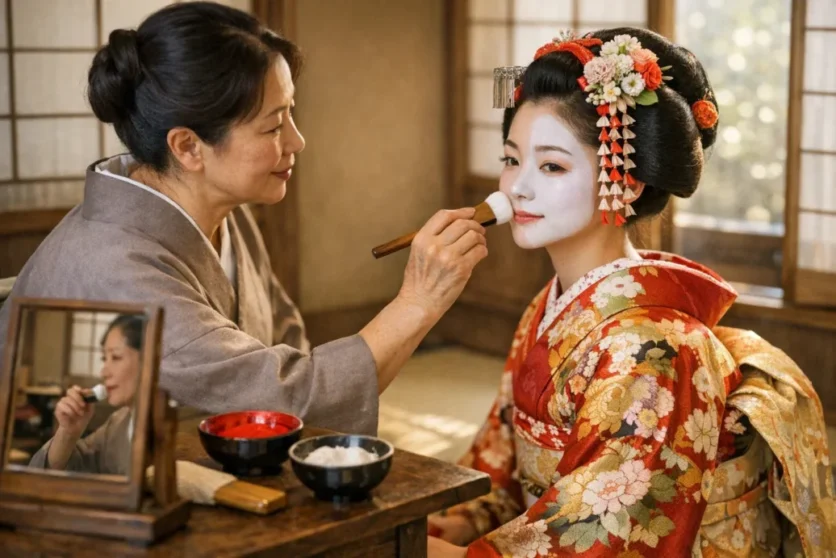
The most recognizable element of Japanese traditional beauty is undoubtedly oshiroi. Historically, this white powder was made from lead-based pigments (which unfortunately caused severe lead poisoning) or rice powder. Today, thankfully, safe synthetic versions are used. Unlike modern foundation, which seeks to match the skin tone, oshiroi is designed to completely mask it. It acts as a blank canvas, erasing the wearer’s natural expression to allow a painted persona to emerge. The application requires mixing the powder with water to create a paste, which is then painted onto the face, neck, and upper chest, leaving specific areas of bare skin exposed for erotic or stylistic effect.
Beni – Red Lip & Eye Pigment
If white is the canvas, red is the soul. Beni is the traditional red pigment extracted from high-quality safflowers. The most prestigious form, Kyō-beni, appears iridescent green in the pot but turns a striking red when applied with water. In Japanese beauty tradition, red is not just a color of passion; it is a color of protection, warding off evil spirits and illness. It is used to contour the eyes (adding a look of vulnerability or sharpness) and to paint the lips. The placement of beni is incredibly precise—it creates the illusion of a smaller, “bud-like” mouth, which was historically considered the height of feminine beauty.
Traditional Brushes & Tools
You cannot achieve these looks with a standard beauty blender. The tools themselves are artifacts of craftsmanship. The hake (flat brush) is essential for applying oshiroi smoothly without streaks. Unlike the fluffy, rounded brushes used in the West, traditional Japanese brushes are often flat and wide, designed to cover large surface areas quickly and evenly. For the intricate details of the eyes and lips, fine-pointed brushes made from animal hair are used. These tools require a skilled hand; the hake must be manipulated with specific wrist movements to ensure the white base looks like porcelain skin rather than cakey paint.
Difference Between Geisha, Maiko, and Kabuki Makeup
Geisha Makeup Style
A fully fledged Geisha (or Geiko in Kyoto) wears makeup that is surprisingly understated compared to her apprentice. The look is defined by “minimal elegance.” While she wears the white oshiroi base, she does not paint her entire lip red. Instead, she paints fully defined lips that are still smaller than her natural lip line, creating a sophisticated look. Crucially, on the back of the neck, a Geisha leaves two prong-like lines of bare skin in the white makeup, known as sanbonashi (or eri-ashi). This area is considered highly erotic in Japanese culture, and the “W” shape highlights the nape of the neck.
Maiko Makeup (Apprentice Style)
The Maiko, or apprentice Geisha, wears a style that is intentionally more youthful and, paradoxically, heavier. Her geisha makeup includes more extensive use of red around the eyes and eyebrows, signaling her youth and immaturity. The most distinct feature is her lips: a first-year Maiko paints only the lower lip red, leaving the upper lip white. As she gains seniority, she begins to paint the upper lip as well. This visual progression allows anyone in the hanamachi (flower town) to instantly recognize her rank and experience level just by glancing at her face.
Kabuki Makeup (Kumadori)
Kabuki makeup, or Kumadori, serves a completely different function: theatrical projection. Unlike the subtle allure of the Geisha, Kabuki makeup is bold, aggressive, and symbolic. Actors paint dramatic lines over their white base to externalize their character’s inner nature. Red stripes indicate a hero, representing justice, passion, and strength. Blue or indigo lines represent villains, ghosts, or jealousy. Brown represents monsters or non-human entities. These lines follow the actor’s facial muscles to exaggerate expressions, ensuring that even audience members in the back row can read the character’s emotions clearly.
Step-by-Step Traditional Japanese Makeup Application
Note: This is a cultural demonstration to understand the process, not a standard beauty tutorial. The authentic application takes years to master.
Skin Preparation & Wax Base
Before any color touches the skin, the canvas must be prepped. Traditional artists use a substance called bintsuke-abura, a special wax or oil. This is melted in the palms and pressed firmly into the face, neck, and chest. This step is non-negotiable. The wax acts as a barrier between the skin and the makeup, protecting the pores. More importantly, it provides the “grip” necessary for the oshiroi to adhere smoothly. Without this sticky base, the white powder would flake off or appear patchy within minutes.
Applying Oshiroi Properly
The oshiroi powder is mixed with water to create a liquid consistency. Using a wide, flat hake brush, the artist paints the neck and back first, then moves to the face. This is often done quickly to prevent drying lines. A sponge or cloth is then patted over the face to absorb excess moisture and ensure an even, matte finish. The goal is not just coverage, but texture—the skin should look like polished porcelain.
Eye, Brow & Lip Detailing
Once the white base is set, the features are drawn back on. Black and red pigments are used to define the eyes and brows. For Geisha, a touch of red is added to the outer corner of the eye. Eyebrows are often painted slightly higher than the natural brow line to create a look of soft surprise or gentleness. Finally, the lips are painted using beni.
2025 Safety Tip: If you are attempting to recreate this look for a costume or performance, never use authentic vintage powders found in antique shops, as they may contain lead. Always opt for modern, cosmetic-grade white paints and powders designed for theatrical use.
Cultural Meaning Behind Traditional Japanese Makeup
Every stroke of the brush in traditional Japanese makeup carries weight. The omnipresent white base represents purity, but historically, it also symbolized discipline. Maintaining a perfect white mask requires limited facial movement; one cannot laugh loudly or grimace without cracking the surface. Thus, the makeup itself enforces a demeanor of poise and restraint. It acts as a physical barrier that separates the artist’s private self from their public persona.
The color red (aka) is equally significant. Representing youth, vitality, and life force, it is used generously on younger apprentices (Maiko) and reduced as a woman matures into a Geisha. This transition visually narrates a woman’s journey from spirited girlhood to refined womanhood. The fading of the red is not a loss of beauty, but a gain in sophistication.
Perhaps the most unique aspect is the treatment of the nape of the neck. In Western culture, the cleavage or legs might be the focal point of attraction. In traditional Japan, the nape (unaji) was the focal point. The specific designs left in the white makeup—two prongs for everyday, three prongs for formal occasions—act as a subtle, visual language. It frames the neck, elongating it and drawing the eye to one of the few areas of “bare” skin, creating a tension between what is hidden and what is revealed.
Traditional Japanese Makeup vs Modern Japanese Beauty
While you won’t see office workers in Tokyo wearing white face paint, the DNA of traditional Japanese makeup is deeply embedded in modern J-Beauty. The contemporary obsession with “translucent” or “mochi” skin is a direct descendant of the oshiroi aesthetic. The goal remains the same: a flawless, pale, and refined complexion, though now achieved with high-tech serums and sunscreens rather than rice powder.
Furthermore, the “bitten lip” trend that dominated Asian beauty recently echoes the Kyō-beni application, where color is concentrated in the center of the lips. The philosophy of minimalism—focusing on skin quality and subtle enhancement rather than heavy contouring—is a legacy of the Geisha’s refined elegance.
In 2025, we are seeing a fascinating resurgence where modern brands are reformulating ancient ingredients. Camellia oil (used for Geisha hair and skin) and rice bran are premium ingredients in luxury skincare. Modern makeup artists are also looking back to traditional color palettes, using the distinct beni red for eyeliners and mascaras, bridging the gap between Edo-period artistry and futuristic Tokyo street style.
Can Traditional Japanese Makeup Be Recreated Today?
Recreating traditional Japanese makeup today is a delicate balance between appreciation and appropriation. It is entirely possible to explore these techniques, but context is key. If you are an artist or student studying the history of makeup, learning the application is a profound way to connect with the culture. However, wearing the full regalia as a “Halloween costume” without understanding the symbols (like the collar designs or hair ornaments) can be seen as disrespectful.
For those wanting to try it, modern alternatives make it safer and easier.
- Pros: You gain an immense appreciation for the skill involved. It serves as a fantastic discipline for brush control and understanding facial anatomy.
- Cons: It is incredibly time-consuming. Authentic Kyō-beni is expensive and rare. The heavy wax base can be comedogenic (pore-clogging) for acne-prone skin if not removed properly with oil cleansers.
Beginners often make the mistake of painting the white base too thick, resulting in cracking, or painting the lips too large. Remember, traditional aesthetics favor negative space. The white space is as important as the painted space.
Common Myths About Traditional Japanese Makeup
The world of Geisha and Kabuki is shrouded in mystery, leading to several persistent myths that need busting.
- Myth: “Geisha were only entertainers for men.”
- Fact: Geisha were, and are, highly skilled artists. They trained for years in dance, shamisen, tea ceremony, and conversation. Their makeup was a uniform of their artistic profession, not merely a tool for seduction.
- Myth: “The white makeup damages the skin.”
- Fact: While the lead-based powders of the past were deadly, the modern version is safe. In fact, the elaborate skincare routine required to prep and clean the skin often leaves professional Geisha with complexion quality that rivals top skincare models.
- Myth: “Traditional makeup is outdated and dead.”
- Fact: It is very much alive. In Kyoto’s Gion district and in Kabuki theaters across Japan, this makeup is applied daily. It is not a museum piece; it is a living, breathing component of Japanese cultural heritage that continues to evolve and inspire.
Why Traditional Japanese Makeup Still Matters in 2025
In a digital world dominated by filters and AI-generated beauty standards, traditional Japanese makeup reminds us of the power of human artistry. It stands as a testament to cultural preservation, proving that some things cannot be digitized. The slow, ritualistic application of the makeup is the antithesis of our “get ready with me in 5 minutes” culture. It demands patience, respect, and skill.
Moreover, its influence on fashion and film remains potent. High fashion runways in Paris and Milan frequently cite Kabuki aesthetics in their avant-garde looks. The global fascination with Japanese culture drives tourism, with thousands flocking to Kyoto hoping to glimpse a Geisha in full regalia. This art form bridges the gap between the ancient world and the modern, proving that true style is timeless.
FAQs – Traditional Japanese Makeup (People Also Ask Based)
What is traditional Japanese makeup?
Traditional japanese makeup refers to historic beauty practices used in Japan, especially by geisha, maiko, and kabuki performers. It includes a white base called oshiroi, red pigments known as beni, and carefully defined eyes and brows. This makeup is not just cosmetic—it represents cultural identity, discipline, and artistic expression rooted in centuries of tradition.
Why do geisha wear white makeup?
Geisha wear white makeup because, historically, a pale complexion symbolized elegance, refinement, and social status in Japan. The white base (oshiroi) also helped facial expressions stand out under candlelight during performances. Beyond beauty, it reflects purity, control, and mastery of traditional arts.
What is the difference between maiko and geisha makeup?
Maiko (apprentice geisha) makeup is more colorful and dramatic, featuring bold red lips, pink eye accents, and ornate hairstyles. Geisha makeup is more refined and minimal, with softer colors and fewer decorative elements. These differences visually represent age, experience, and professional status within traditional Japanese culture.
Is traditional Japanese makeup still used today?
Yes, traditional japanese makeup is still used today, mainly in cultural performances, festivals, ceremonies, and tourism experiences—especially in Kyoto. While daily use is rare, its influence remains strong in modern Japanese beauty, fashion, film, and editorial makeup styles.
Can anyone wear traditional Japanese makeup?
Anyone can recreate traditional Japanese makeup, but it should be done respectfully and with cultural understanding. Many people today use modern, skin-safe alternatives instead of traditional materials. Learning the history and symbolism behind the makeup helps avoid cultural misrepresentation.
What products are used in traditional Japanese makeup?
Traditional japanese makeup uses oshiroi (white powder foundation), beni (red pigment for lips and eyes), natural wax bases, and handmade brushes. In modern recreations, professional makeup products are often substituted to ensure safety while maintaining the traditional look.
How is kabuki makeup different from geisha makeup?
Kabuki makeup, known as kumadori, is bold and theatrical, using strong red, black, and blue lines to represent character traits like strength or villainy. Geisha makeup is elegant and subtle, focusing on grace rather than exaggerated expression. Both styles serve different artistic purposes.
Does traditional Japanese makeup damage the skin?
Traditional formulas could be heavy and drying, but modern recreations use skin-friendly cosmetics. When applied correctly and removed properly, traditional japanese makeup styles can be worn safely without harming the skin.
Conclusion
Traditional Japanese makeup is far more than a painted face; it is a discipline that honors history, hierarchy, and art. From the stoic white mask of the Geisha to the fierce red lines of Kabuki, these styles tell the story of a culture that finds beauty in ritual and meaning in every detail.
As we move through 2025, understanding these ancient practices allows us to appreciate the depth of Japanese culture beyond the surface level. It challenges us to see makeup not just as a way to look good, but as a way to embody a story. Whether you are studying the technique or simply admiring the artistry, remember that beneath the powder and paint lies a centuries-old spirit of resilience and grace.
Leave feedback about this