

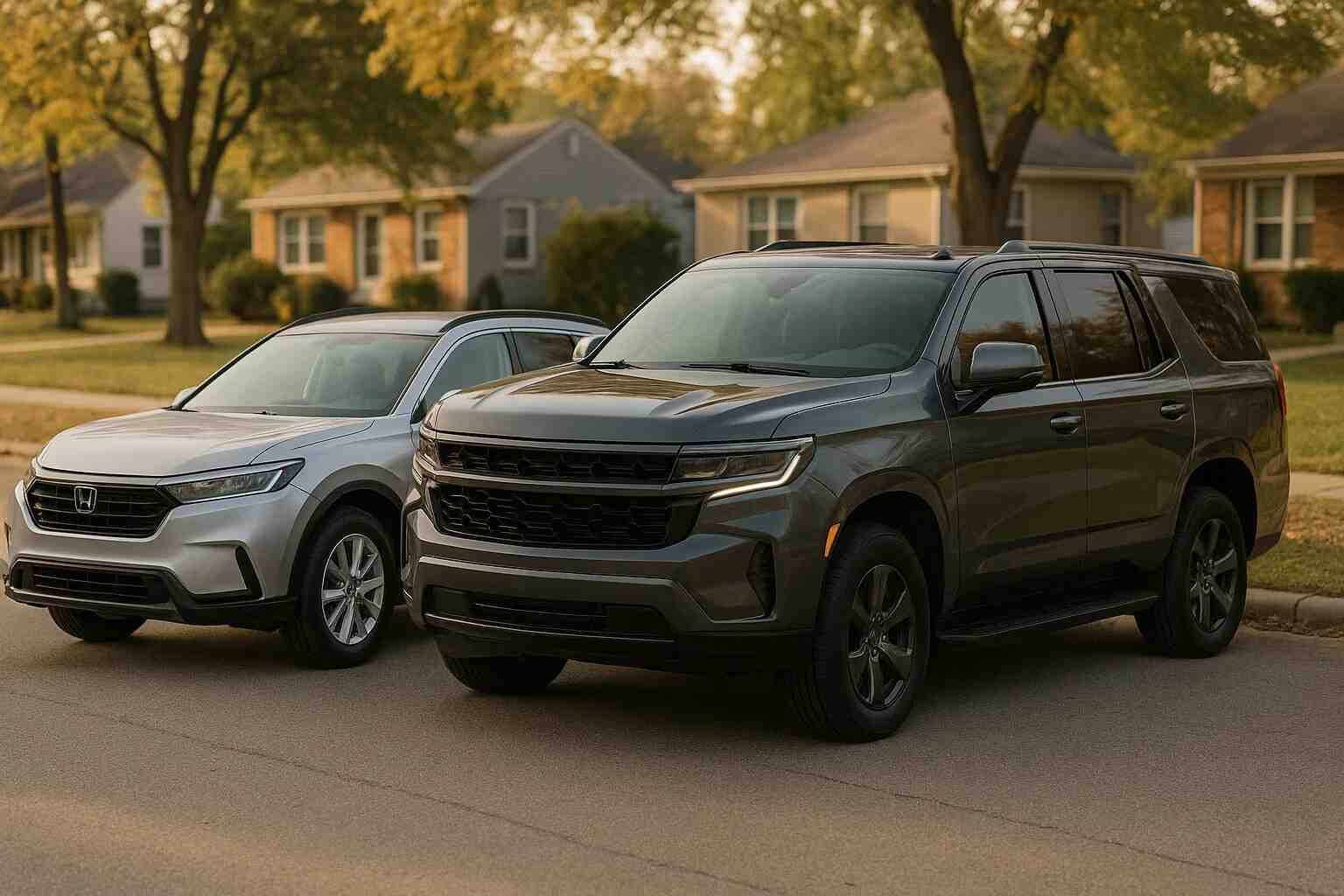
2025 Crossover SUV vs Traditional SUV Comparison USA – Fuel, Towing & Cost Explained
Quick Verdict: When to Pick a Crossover vs a Traditional SUV
If you mainly drive on paved roads, want great fuel economy, and prefer easy handling — a crossover SUV is your best choice. However, if you regularly tow heavy loads, go off-road, or need rugged durability, a traditional SUV is built for that job.
Here’s a quick breakdown:
- Commuters and families: Crossovers like the 2025 Honda CR-V or Toyota RAV4 are ideal — smooth ride, easy parking, and 30+ MPG.
- Outdoor enthusiasts & towers: Traditional SUVs such as the Chevrolet Tahoe or Ford Expedition handle towing trailers up to 8,500 lb and rough terrain better.
- Budget-focused buyers: Crossovers generally cost less to buy, insure, and fuel.
- Heavy-duty users: Traditional SUVs win on payload and durability.
Decision Flow Example:
If you tow under 3,000 lb → pick a Crossover
If you tow over 3,000 lb → choose a Traditional SUV
What Is a Crossover? (Build & Definition)
A crossover SUV (CUV) is built on a unibody car platform — meaning the frame and body are a single structure. This design makes crossovers lighter, smoother to drive, and more fuel efficient than truck-based SUVs.
Most modern crossovers use front-wheel drive (FWD) with optional all-wheel drive (AWD). They’re designed for comfort and everyday practicality — perfect for commuting, city life, and light snow or gravel.
Popular 2025 crossover examples:
- Honda CR-V Hybrid (2025) — balanced fuel economy (up to 40 MPG combined)
- Toyota RAV4 — strong reliability, great resale value
- Hyundai Tucson — advanced tech and safety features
- Mazda CX-50 — upscale interior and AWD confidence
Crossovers dominate the U.S. market because they blend the best traits of cars (easy handling, comfort) and SUVs (higher seating position, cargo versatility).
What Is a Traditional SUV? (Build & Definition)
A traditional SUV uses body-on-frame construction, similar to pickup trucks. This design offers superior strength, making these vehicles ideal for heavy towing, off-roading, and rugged use.
Traditional SUVs typically use rear-wheel drive (RWD) or four-wheel drive (4WD) systems with low-range gearing. They have higher ground clearance, tougher suspensions, and greater durability under load.
Common 2025 examples:
- Chevrolet Tahoe / Suburban
- Toyota 4Runner
- Ford Expedition
- Jeep Wrangler / Wagoneer
While heavier and less fuel-efficient, these SUVs excel in towing (up to 9,000 lb+), off-road performance, and longevity. If your lifestyle involves trailers, dirt trails, or camping gear, a traditional SUV is unbeatable.
Key Technical Differences Explained: Chassis, Suspension, Drivetrain
| Feature | Crossover SUV | Traditional SUV |
|---|---|---|
| Frame | Unibody (car-based) | Body-on-frame (truck-based) |
| Drive layout | FWD or AWD | RWD or 4WD |
| Ride comfort | Smoother, car-like | Firm, rugged |
| Towing | Light-duty (1,500–3,500 lb) | Heavy-duty (5,000–9,000 lb) |
| Off-road ability | Limited | Excellent |
| Weight | Lighter | Heavier |
| Fuel economy | Higher | Lower |
Crossovers prioritize refinement and efficiency, while traditional SUVs favor strength and toughness.
A unibody design absorbs bumps better and improves crash safety, but body-on-frame construction isolates vibrations and makes repairs easier after off-road damage.
Real-World Performance: Fuel Economy, Handling, and Comfort
Crossovers generally outperform traditional SUVs in fuel economy and daily drivability.
According to 2025 EPA data:
- Compact crossovers average 28–35 MPG
- Midsize SUVs average 18–25 MPG
Crossovers have lower centers of gravity, so they handle corners and urban traffic like sedans. Their suspension tuning emphasizes comfort and road quietness — ideal for long commutes.
Traditional SUVs, though less efficient, provide commanding road presence and high seating position, giving drivers a sense of control. Newer models like the 2025 Ford Expedition Hybrid narrow the gap with 23 MPG combined — impressive for its size.
In short:
- Crossovers = comfort + efficiency
- SUVs = power + stability
Towing, Payload, and Off-Road Capability
When it comes to towing and payload, body-on-frame SUVs dominate.
- Crossovers: typically 1,500–3,500 lb towing
- Traditional SUVs: 5,000–9,000 lb+
If you plan to tow a camper, boat, or utility trailer, a traditional SUV like the Chevy Tahoe or Jeep Wagoneer is your best bet.
Off-roaders also benefit from features like:
- 4WD with low range
- Locking differentials
- Skid plates and high ground clearance
Crossovers, while capable of light dirt roads (e.g., Subaru Outback, Mazda CX-50), aren’t built for rock crawling or deep mud.
Bottom line:
Choose SUV for towing, CUV for everyday versatility.
Cost Comparison: Purchase Price, Insurance, Maintenance, Depreciation
Crossovers are cheaper to buy, fuel, and insure. Traditional SUVs carry higher upfront costs and running expenses.
Example Cost Range (2025 US Market):
| Category | Crossover | Traditional SUV |
|---|---|---|
| Starting Price | $27,000–$40,000 | $45,000–$80,000 |
| Insurance (avg/year) | $1,300 | $1,800 |
| Fuel (annual est.) | $1,200 | $2,000 |
| Maintenance | Moderate | Higher (due to size, tires, brakes) |
| Depreciation | Slower | Faster on large SUVs |
However, SUVs may hold value better in certain niches (off-road and 4WD enthusiasts). Crossovers appeal to mainstream buyers, so their resale demand remains strong.
For total cost of ownership (TCO), most drivers save 20–30% long-term with crossovers.
Safety & Driver Assists: Are Crossovers Safer?
Modern crossovers score excellent crash ratings thanks to unibody construction and advanced driver-assist tech like adaptive cruise control, blind-spot monitoring, and lane-keep assist.
Traditional SUVs’ heavier build can offer better protection in multi-vehicle crashes, but they have higher rollover risk due to center of gravity.
Safety examples (2025):
- Honda CR-V — IIHS Top Safety Pick+
- Toyota Highlander — strong frontal crash protection
- Jeep Wagoneer — body strength + stability control
For child-seat access and daily ease, crossovers often win. However, both categories now offer ADAS features across trims, narrowing the safety gap.
Electric & Hybrid Impact: How Electrification Blurs the Line
Electrification is changing the SUV landscape. Many 2025 crossovers and SUVs use hybrid or full-EV platforms, reducing traditional fuel-efficiency differences.
Examples:
- Tesla Model Y (unibody EV crossover)
- Rivian R1S (body-on-frame EV SUV)
- Ford Explorer Hybrid / Expedition Hybrid
- Toyota Highlander Hybrid
EVs erase some of the old distinctions — battery placement lowers center of gravity and improves stability. Yet, towing range still limits many EV crossovers.
In 2025, the “crossover vs SUV” line blurs further as automakers merge rugged looks with electric efficiency.
Use-Case Scenarios: Which Vehicle Fits Your Lifestyle?
1. Family Commuter:
Live in the suburbs, drive kids to school, and want great MPG? → Choose a Crossover (e.g., 2025 RAV4 Hybrid).
2. Outdoor Enthusiast:
Haul camping gear or boats every weekend? → Choose a Traditional SUV (e.g., Ford Expedition, Chevy Tahoe).
3. Urban Professional:
Value tech, comfort, and compact size? → A Crossover fits city parking and commutes perfectly.
4. Off-Road Adventurer:
Love dirt trails and mountains? → Go with a Jeep Wrangler or Toyota 4Runner.
5. Luxury Seeker:
Want premium comfort? → Both categories shine — try Lexus RX ( crossover ) or Cadillac Escalade ( SUV ).
Pros & Cons: Crossover vs Traditional SUV
| Aspect | Crossover SUV | Traditional SUV |
|---|---|---|
| Fuel Efficiency | Excellent (28–35 MPG) | Moderate (18–25 MPG) |
| Ride Comfort | Smooth, car-like | Firm, truck-like |
| Towing | 1,500–3,500 lb | 5,000–9,000 lb+ |
| Off-Road | Light trails only | Serious terrain |
| Price | Lower | Higher |
| Cargo Space | Moderate | Large |
| Maintenance | Cheaper | Costlier |
| Insurance | Lower | Higher |
| Handling | Agile | Heavy but stable |
| Ideal For | Families, commuters | Adventurers, towers |
How to Choose: Checklist & Test-Drive Script
Before deciding, use this quick checklist:
✅ Define your priorities: Towing, MPG, space, or comfort?
✅ Test drive both types: Compare seating height, handling, and road noise.
✅ Check towing needs: Trailer weight × 1.2 = required tow rating.
✅ Compare insurance quotes: SUVs often cost 20–30% more to insure.
✅ Consider parking space: Large SUVs may not fit tight garages.
✅ Review long-term budget: Factor in fuel, tires, and resale value.
During test drive:
Note acceleration, braking, visibility, and comfort. Ask the dealer about 2025 hybrid options — many crossovers now combine SUV practicality with hybrid efficiency.
Conclusion: Final Recommendation
When comparing crossover SUVs vs traditional SUVs, your lifestyle is the deciding factor.
Pick a Crossover SUV if you prioritize comfort, MPG, affordability, and city convenience.
Pick a Traditional SUV if you need towing strength, off-road toughness, or maximum space.
In 2025, crossovers dominate urban roads, while full-size SUVs remain kings of adventure.
Quick takeaway:
Daily commuter? → Crossover.
Weekend tower or adventurer? → SUV.
Choose smart — match your vehicle to your real-world needs, not just looks.
FAQ: Common Questions About Crossovers vs SUVs
What’s the difference between a crossover and a traditional SUV?
A crossover (CUV) is built on a car’s unibody platform, offering better fuel economy and ride comfort. A traditional SUV uses body-on-frame construction, ideal for towing and rugged use.
Are crossovers safer than traditional SUVs?
Both are safe when equipped with modern features. Crossovers usually score higher in crash tests, while heavier SUVs offer more protection in collisions but slightly higher rollover risk.
Which is more fuel efficient: crossover or SUV?
Crossovers are generally more efficient, averaging 30 MPG versus 20 MPG for full-size SUVs. Hybrid and EV versions can close this gap further.
Can a crossover tow as much as a traditional SUV?
Not usually. Crossovers tow around 3,000 lb; large SUVs handle up to 9,000 lb+. If towing is routine, go with a truck-based SUV.
Is a crossover better for families than an SUV?
For daily family driving, yes — crossovers are smoother, quieter, and easier to park. Larger families needing three rows or heavy cargo space may prefer a full-size SUV.
Are crossovers cheaper to insure than SUVs?
Yes. Crossovers typically cost 15–25% less to insure because of lower repair costs and smaller engines.
How has electrification changed the crossover vs SUV debate?
EVs like the Tesla Model Y and Rivian R1S blur the line, combining smooth unibody handling with truck-like power. The future is hybrid and electric, where size no longer defines efficiency.
How the Advantages of Cobots Over Traditional Robots USA Are Changing Factory Floors





Leave feedback about this