

6 Things Hanbok Korean Traditional Clothing Reveals About Korea
According to the National Folk Museum of Korea, the hanbok — Korea’s traditional dress — has been documented as a continuous clothing practice for over 1,600 years, with visual records dating back to Goguryeo dynasty murals from the 4th century CE. That’s not a fashion trend. That’s a living cultural institution that survived colonial suppression, rapid industrialization, and the complete restructuring of Korean society across the 20th century. The fact that hanbok is still worn today, adapted by a new generation of Korean designers and embraced by millions across the US and UK through K-drama and K-pop, says something meaningful about how deeply it’s rooted.
This article covers the full picture of hanbok Korean traditional clothing: what the individual garments are called, how men’s and women’s versions differ structurally, what the color and fabric systems historically communicated, and how South Korean traditional clothing functions in modern life — both inside Korea and in Western countries. If you’ve seen hanbok on screen and wanted to understand what you’re actually looking at, or if you’re planning to wear or buy one, everything you need is here.
Most articles on this topic either stay vague or turn into shopping guides within the first few paragraphs. This one doesn’t. It covers the practical construction of each garment component, the honest limitations of wearing hanbok outside its cultural context, and the specific differences between authentic traditional hanbok and the neo-hanbok versions that have exploded in popularity since 2018 — a distinction most English-language sources still fail to explain properly.
Hanbok Korean Traditional Clothing: What Each Garment Is and What It Does
Hanbok is not a single garment. It is a coordinated dress system — the word itself simply means “Korean clothing” — and understanding it requires knowing what each component is called and why it exists. The confusion between the whole ensemble and any individual piece is the most common mistake non-Korean audiences make when first encountering it.
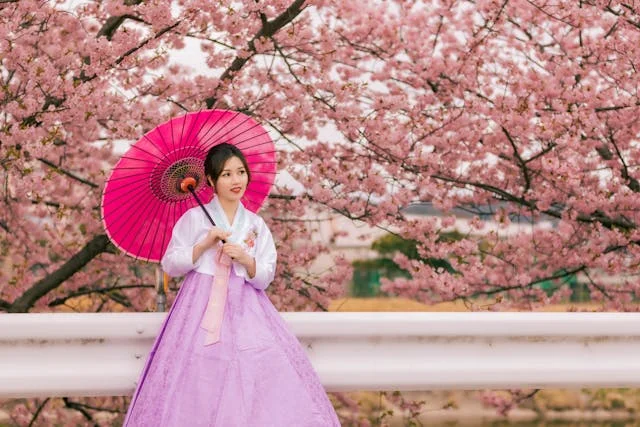
For women, the two essential pieces are the jeogori and the chima. The jeogori is the upper jacket — cropped, with long tapered sleeves, a V-shaped collar called a git, and a long decorative ribbon closure at the chest called the goreum. The chima is the full wraparound skirt worn high on the ribcage, gathered and tied just below the bust, falling in a wide bell shape to the floor. These two pieces together create the silhouette that defines women’s Korean traditional dress: a small fitted top over a dramatically voluminous skirt.
For men, the hanbok consists of a longer jeogori — falling to the hip rather than the chest — worn over wide-legged trousers called baji, tapered and tied at the ankles. Over this, men typically add a long outer coat called a po, with several formal variants including the dopo (worn by scholars) and the simui (a white ceremonial coat). Both men and women wear white undergarments called sokot beneath the visible layers, and the traditional footwear is a curved boat-shaped shoe called hye, historically made from silk or woven straw depending on social rank.
Children’s hanbok carries its own visual language. At the dol — the first birthday celebration, one of Korea’s most significant family milestones — young children wear the saekdong style, featuring vivid stripes of red, blue, yellow, and green across the sleeves. This rainbow-stripe pattern is called saekdong and functions as a blessing symbol: the variety of colors represents abundance, health, and protection across all directions.
What Color and Fabric Communicated in South Korean Traditional Clothing
Color in hanbok was never arbitrary. During the Joseon dynasty (1392–1897), Korea operated under detailed sumptuary laws that dictated which colors, fabrics, and accessories each social class could wear. According to the Ewha Womans University Museum in Seoul, violations of these dress codes were treated as serious social transgressions, and clothing functioned as a publicly readable system of rank, marital status, and occasion.
Commoners wore white, off-white, or pale grey — undyed or minimally processed ramie and hemp. This is where Korea’s historical identity as the “white-clad people” originates: not from poverty, but from a deliberate aesthetic that valued simplicity and was regulated from above. Vivid colors like crimson red, deep indigo, and emerald green were restricted to the nobility and royal court. The royal family wore specific shades of red and yellow that ordinary citizens were prohibited from using entirely.
Fabric quality tracked precisely with social standing. Lightweight silk gauze called sa and fine woven silk ramie were reserved for aristocratic yangban families. Cotton and coarser hemp were the materials of commoners. The physical difference between a yangban’s jeogori and a commoner’s was visible from a distance — which was precisely the point. If you want to see how neighboring cultures applied similar systems, the detailed breakdown of traditional Japanese royal clothing and its rank-based hierarchy offers a useful comparison.
Embroidery called ja-su added symbolic weight to ceremonial garments. Phoenixes and peonies appeared on women’s wedding hanbok. Cranes — symbols of longevity and scholarly virtue — decorated official court robes. Bats, counterintuitively in the Western eye, were considered highly auspicious and appeared frequently on celebratory garments because the Korean word for bat shares a sound with the word for good fortune.
Quick Note: The terms “Korean traditional dress” and “hanbok traditional” both refer to the same garment system. “Hanbok” is the correct and universally accepted term in both Korean and English — use it when searching for rental services, cultural events, or purchasing authentic pieces, as it will return far more accurate results than broader search terms.
Men’s vs Women’s Hanbok: The Structural Differences That Matter
The silhouette difference between men’s and women’s hanbok is more dramatic than most outsiders expect. Women’s hanbok is defined by the extreme contrast between the very short jeogori and the very full chima — a proportion that became progressively more exaggerated across the Joseon dynasty, reaching its most dramatic in the late 19th century when the jeogori barely covered the chest. Men’s hanbok, by contrast, maintains a longer jacket that sits comfortably at the hip, with proportions that feel closer to what a Westerner might recognize as a coat-and-trouser combination.
The formal outer layers diverge significantly between genders. Women add the durumagi — a long outer coat — for cold weather or formal occasions, and the wonsam, a wide-sleeved ceremonial robe, for weddings and court appearances. Men’s formal dress incorporated an entirely different system of hats and coats that signaled rank and role. The gat — a wide-brimmed hat woven from black horsehair — is perhaps the single most recognizable element of men’s joseon-era dress. It was worn exclusively by educated adult men of yangban status, and its presence in a portrait or street scene immediately communicated the wearer’s social position.
Wedding hanbok follows specific color conventions that remain in use today. Brides traditionally wear red and blue together — red representing yang (warmth, fire, south) and blue representing eum (coolness, water, north) — with the two colors together signifying balance and harmony in marriage. Grooms typically wear blue or darker neutral tones with formal outer robes. These conventions have remained largely intact in modern weddings even when other elements of the ceremony have become Westernized, which speaks to how deeply the color symbolism is embedded in the cultural understanding of the occasion.
Neo-Hanbok vs Traditional Hanbok: What the Difference Actually Means
Since approximately 2018, a distinct category called neo-hanbok has become genuinely significant both in Korea and internationally. Neo-hanbok retains the essential silhouette of the chima and jeogori — the high waist, the full skirt, the cropped jacket — but uses contemporary fabrics like cotton, linen, organza, and synthetic blends, simplifies the construction to allow for independent dressing without assistance, and often incorporates modern colors, prints, and closures like zippers and snaps rather than traditional ribbon ties.
Seoul-based brands Leesle and Hanboknam have been central to this movement, producing neo-hanbok pieces that start around $80–$150 for separates and are designed to function as actual daily wear rather than ceremonial dress. In the UK, Korean cultural communities in New Malden (Surrey) have seen growing interest in neo-hanbok for community events and celebrations, and several London-based Korean designers have begun producing their own interpretations for British customers.
Our take: neo-hanbok is not a dilution of the tradition — it is the tradition continuing to evolve, which is exactly what living clothing cultures do. Traditional full-silk hanbok is magnificent and worth experiencing, but it requires assistance to put on correctly, restricts movement considerably, and needs specialist cleaning. If you want to actually wear hanbok regularly rather than once for a palace visit, neo-hanbok from Leesle or a comparable quality maker is the practical choice. Paying $150 for a well-made neo-hanbok set that you’ll wear multiple times is a better decision than spending $40 on a cheaply made costume version that does neither tradition nor your wardrobe any favors.
The honest trade-off is this: neo-hanbok, while wearable and culturally respectful, does not carry the same visual impact or tactile experience as traditional silk hanbok. If you are attending a formal Korean ceremony — a wedding, a hwangap 60th birthday celebration, a major dol — traditional hanbok is still the appropriate choice, and rental services near major Korean cultural centers in both the US and UK can provide it. For casual cultural events, community festivals, or personal interest, neo-hanbok is entirely appropriate. A similar practical distinction between historical and contemporary versions of national dress exists for Irish traditional dress and most other living cultural clothing traditions.
How Hanbok Is Worn Today in the US, UK, and Modern Korea
Inside Korea, hanbok is worn on specific occasions rather than daily. The two most significant are Seollal (Lunar New Year) and Chuseok (the harvest festival), when families dress in hanbok to perform ancestral rites called charye. Weddings remain a major occasion, with hanbok worn not just by the couple but often by immediate family members. The dol first birthday and hwangap 60th birthday celebrations are other key moments when hanbok appears as expected rather than exceptional dress.
The Korean tourism industry has made hanbok rental a central visitor experience. Near Gyeongbokgung, Changdeokgung, and other major Seoul palaces, dozens of rental shops offer hanbok for roughly 10,000–20,000 Korean won (approximately $7–$15 USD) for several hours, and wearing hanbok grants free entry to the palace grounds. According to the Korea Tourism Organization, palace hanbok rental became one of the top five tourist activities in Seoul between 2016 and 2019, driven largely by international visitors wanting the experience of walking a Joseon-era site in period dress.
In the US, Korean-American communities across Los Angeles, New York, Chicago, and the Washington DC area hold regular Seollal and Chuseok events where hanbok is prominently worn. The Korean Cultural Center USA, with offices in multiple cities, runs hanbok education events year-round. In the UK, the Korean Cultural Centre in London and the large Korean community in New Malden host similar programming. For comparison with how other cultures navigate traditional dress in diaspora communities, the approach is not unlike how Chinese traditional outfit traditions are maintained and adapted within Chinese-American and Chinese-British communities.
For non-Korean audiences in the US and UK who want to engage with hanbok respectfully, the most straightforward options are: attending a Korean cultural event where hanbok is worn by community members and welcomed on visitors; visiting Korea and participating in palace rental; or purchasing neo-hanbok from a Korean-owned maker for personal wear at multicultural events. What makes the difference between respectful engagement and careless appropriation is context and quality — wearing a well-made hanbok at a Korean cultural festival reads very differently from wearing a thin costume version with no cultural awareness attached to it.
Frequently Asked Questions
What is the difference between hanbok and neo-hanbok?
Traditional hanbok is made from silk or ramie, uses ribbon ties called goreum for closures, requires layered undergarments, and is typically worn for formal ceremonies. Neo-hanbok uses contemporary fabrics like cotton and linen, simplifies the construction for independent dressing, and incorporates modern design details while maintaining the essential hanbok silhouette — particularly the high-waisted chima skirt and the short jeogori jacket. Neo-hanbok is designed for regular wear rather than ceremonial occasions. The distinction matters if you’re deciding what to buy or wear to a specific event: traditional hanbok for weddings and ancestral rites, neo-hanbok for cultural events and personal interest.
Is it disrespectful for non-Koreans to wear hanbok?
Generally, no — and this position is supported by both the Korean Tourism Organization and Korean cultural organizations in the US and UK, which actively invite international visitors to try hanbok. The Korean cultural perspective on hanbok sharing has historically been one of openness, particularly when worn in genuine cultural contexts like palace visits, Korean festivals, or community celebrations. The situations that draw criticism are costume versions worn without cultural acknowledgment, or hanbok elements mixed into fashion contexts that strip them of meaning. Wearing quality hanbok at an appropriate event with basic awareness of what it represents is respectful participation, not appropriation.
How much does a hanbok cost to buy?
Prices vary considerably by material and maker. Neo-hanbok separates from quality Korean brands like Leesle start around $80–$150 per piece. A full traditional silk hanbok from an established Korean atelier runs $400–$2,000 or more depending on fabric quality and embroidery. Cheaper versions on general retail platforms exist in the $30–$80 range but are typically poor quality and often inaccurate in construction — they function as costumes rather than genuine hanbok. If budget is a concern, hanbok rental through Korean cultural centers in major US and UK cities is a practical alternative that provides access to well-made pieces without the purchase cost.
What do the colors of a wedding hanbok mean?
Traditional Korean wedding hanbok uses red and blue together for the bride, representing yin and yang — the complementary forces that create balance in marriage. Red carries associations with warmth, fire, and positive energy; blue with calm, water, and constancy. The groom traditionally wears blue or darker neutral tones with formal outer robes. These color conventions are not merely decorative — they communicate a complete cosmological understanding of marriage as a balancing of complementary forces. Modern Korean weddings often incorporate Western white dress elements alongside or instead of hanbok, but families who choose traditional ceremonies maintain these color associations.
How do you put on a hanbok correctly?
Women’s hanbok begins with the white sokot undergarments, followed by the chima skirt, which wraps and ties at the high waist just below the bust. The jeogori jacket goes on last, with the goreum ribbons tied in a specific bow at the right side of the chest — not centered, and not in a simple knot. The bow shape and placement vary slightly by region and period. Men’s hanbok follows a similar layering sequence: undergarments first, then baji trousers tied at the waist and ankles, then the jeogori, then the outer po coat. Most people putting on hanbok for the first time benefit from assistance, which is why rental shops include a dressing service. Attempting to tie the goreum correctly without guidance typically results in an uneven or structurally wrong result.
How is South Korean traditional clothing different from North Korean dress?
The base hanbok tradition is shared across the Korean peninsula, as the division only occurred in 1945. However, North Korean hanbok has evolved somewhat differently under state direction, with the government promoting specific approved styles and color palettes that differ from South Korean developments. North Korean women’s hanbok tends toward longer, less cropped jeogori versions and more muted colors in everyday wear, while South Korean hanbok — particularly neo-hanbok — has moved in a more contemporary, color-flexible direction. The ceremonial versions in both countries remain closer to the Joseon-era originals, but stylistic drift has occurred over 80 years of separation.
Final Thoughts
Hanbok Korean traditional clothing is one of the most immediately recognizable national dress traditions in the world — and one of the most misunderstood in English-language coverage. The silhouette is distinctive enough to be globally iconic, but what actually makes hanbok significant is the layered system beneath the surface: the garment names, the color hierarchies, the social logic, the ceremonial functions, and the ongoing negotiation between tradition and contemporary life that neo-hanbok represents. Understanding that system gives you a genuinely different relationship to the garment than treating it as a visual novelty.
If you want one concrete next step: find a Korean cultural event in your city — Seollal and Chuseok celebrations are held in most major US and UK cities every year — and attend. You will see hanbok worn by people for whom it carries real meaning, which is the most useful context you can get outside of visiting Korea itself. For broader context on how traditional dress systems function across cultures, the history of traditional Canadian outfit traditions and the cultural depth behind female Arabian traditional dress are worth reading alongside this one.



Leave feedback about this