

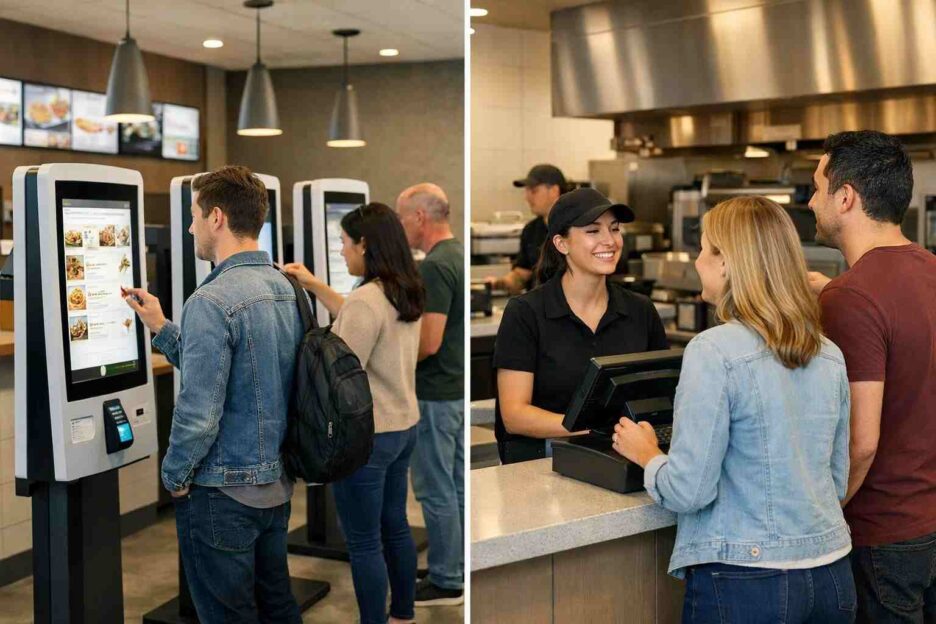
Kiosk Ordering vs Traditional Ordering: Is Self-Service Right for Your Business?
Kiosk ordering has moved from novelty to infrastructure in many customer-facing environments. Yet for every operator that has rolled out self-service successfully, there are others where staffed counters continue to perform better. The decision is rarely binary. It depends on customer behaviour, operational constraints, cost structures and the type of experience a business is trying to deliver.
This article compares kiosk ordering with traditional counter-based ordering through a decision-making lens. Rather than promoting one model over the other, it examines where each approach performs well, where it struggles, and how operators can evaluate the right mix for their business.
Kiosk Ordering vs Staffed Counters: An Overview
Traditional ordering relies on direct interaction between customers and staff. Orders are taken verbally, entered into a POS system, paid for and passed to fulfilment. The model is flexible and familiar but limited by one-to-one throughput.
Kiosk ordering replaces the order-taking step with a self-service interface. Customers browse menus, customise items and pay independently, while staff focus on preparation and support. The system standardises how orders are captured, but reduces real-time human judgement at the point of sale.
The practical difference is not just technological. It changes queue dynamics, staff roles and how customers perceive control over the ordering process.
Speed, Accuracy and Order Value Comparison
Speed
In low-traffic environments, staffed counters are often faster. A trained employee can process simple orders quickly without customers needing to navigate menus.
However, during predictable peaks — such as lunchtime in food courts or between classes on university campuses — kiosk ordering scales more effectively. Multiple customers can order simultaneously, reducing visible queues even if fulfilment time remains unchanged.
The key distinction is parallel vs sequential processing. Kiosks excel where order volume spikes and choices are structured.
Accuracy
Kiosk ordering generally improves accuracy for customisable products. Customers select options directly, reducing misheard requests or incorrect substitutions.
Traditional ordering performs better where orders are conversational or ambiguous, such as cafés with frequent off-menu requests or hospitality settings where staff recommendations influence final choices.
Accuracy gains from kiosks are most noticeable when menus are fixed and modifiers are clearly defined.
Order Value
Research and operator data consistently show that self-service can influence basket composition, but not always in predictable ways.
Kiosk ordering can increase attachment rates for extras when prompts are well-designed. However, poorly structured interfaces can slow users down or lead them to skip optional items entirely.
Staffed counters can outperform kiosks in environments where upselling relies on timing, tone and personal rapport rather than prompts on a screen.
Staffing and Labour Implications
One of the most common misconceptions is that kiosk ordering simply reduces labour costs. In practice, it redistributes labour.
With kiosks:
- Fewer staff are required for order intake
- More staff time shifts to fulfilment, quality control and customer assistance
- Supervisory roles become more important during peak periods
Traditional counters require more front-of-house staffing but allow experienced employees to manage exceptions and adapt to changing conditions in real time.
For operators facing high staff turnover or recruitment challenges, kiosk ordering can stabilise operations. For businesses built around personal service, removing order-taking can undermine the core experience.
Customer Satisfaction and Accessibility Concerns
Customer satisfaction varies widely depending on demographic and context.
Kiosk ordering appeals to:
- Repeat customers
- Time-sensitive users
- Customers who prefer minimal interaction
It frustrates:
- First-time visitors
- Less confident technology users
- Customers with accessibility needs if interfaces are poorly designed
Traditional ordering remains important for inclusivity. Verbal interaction allows staff to adapt pace, clarify confusion and assist customers who struggle with screens or payment terminals.
From an accessibility standpoint, kiosks require careful consideration of screen height, contrast, language options and alternative input methods. A single poorly designed kiosk can create friction rather than efficiency.
Cost Considerations Over Time
Upfront and Ongoing Costs
Kiosk ordering introduces capital expenditure (hardware) and ongoing operational costs (software, maintenance, payment compliance). These costs are relatively fixed regardless of transaction volume.
Traditional ordering has lower upfront costs but scales linearly with labour. As wages rise or trading hours extend, staffing costs increase accordingly.
Long-Term Cost Dynamics
Kiosk ordering tends to perform better financially when:
- Order volume is high and predictable
- Menus are stable
- Locations operate long hours
Traditional counters remain more cost-effective in:
- Low-volume environments
- Seasonal or irregular trading patterns
- Businesses with frequent menu changes or specials
The break-even point is operational, not theoretical. It depends on how consistently kiosks are used and whether staffing levels are actually adjusted as a result.
Hybrid Ordering Models
For many operators, the most resilient solution is hybrid.
A hybrid model might include:
- Kiosks for standard orders
- A staffed counter for assistance and exceptions
- Mobile ordering for pre-orders or repeat customers
This approach reduces risk. Customers self-select their preferred channel, and operations can flex based on demand rather than forcing a single behaviour.
Hybrid models also allow gradual adoption. Operators can observe usage patterns before committing fully to kiosk-heavy layouts.
Businesses Where Kiosk Ordering May Not Work
Kiosk ordering is not well suited to every environment.
It often underperforms in:
- Small independent cafés with conversational ordering
- Premium hospitality where service is part of the value proposition
- Environments with highly variable or verbal customisation
- Locations with low digital literacy among core customers
In these cases, kiosks can feel impersonal or slow, adding friction rather than removing it.
A Decision Framework for Operators
When evaluating kiosk ordering versus traditional ordering, operators should consider:
- Order Volume and VariabilityAre peaks predictable, and do queues regularly form?
- Menu StructureAre products standardised or heavily customised through conversation?
- Customer DemographicsAre customers comfortable with self-service, or do they expect interaction?
- Labour ConstraintsIs staffing availability or cost a limiting factor?
- Physical SpaceIs there room for kiosks without creating congestion?
- Accessibility RequirementsCan kiosks be implemented without excluding certain users?
If the answers point in different directions, a hybrid approach is often the most robust.
Conclusion
Kiosk ordering is neither a universal upgrade nor a threat to traditional service. It is a tool — effective in some contexts, counterproductive in others. The strongest operators treat the decision as an operational design question rather than a technology trend.
By focusing on workflow, customer needs and long-term cost dynamics, businesses can determine whether kiosk ordering enhances their operation, complements existing models, or should remain a limited option rather than a default.





Leave feedback about this