
How to Choose Korean Traditional Clothing for Men
The Victoria and Albert Museum in London dates the earliest depictions of hanbok — traditional Korean clothing for men and women — to tomb murals from the Goguryeo period, roughly the 4th to 6th century CE, making it one of the oldest continuously documented clothing traditions in East Asia. That is not a claim most fashion histories can make. What you are looking at when you see a man dressed in hanbok is not a costume or a replica: it is a living garment with more than fifteen centuries of documented use behind it.
This article covers everything a man in the USA or UK needs to know about Korean traditional male clothing — from the names and functions of each garment, to how social rank shaped color choices, to what “modern hanbok” actually means in practice and whether it is worth wearing outside of Korea. It covers occasions, fabrics, accessories, and where the common misconceptions come from.
Most guides on this topic either stay at surface level — mentioning jeogori and baji and moving on — or they are written primarily for tourists visiting Seoul. This article goes further. It addresses the specific gaps those articles skip: the layering system, what class distinctions meant for color and fabric, and what the modern hanbok revival actually looks like for men who want to wear one in the West.
The Core Garments in Korean Traditional Clothing for Men
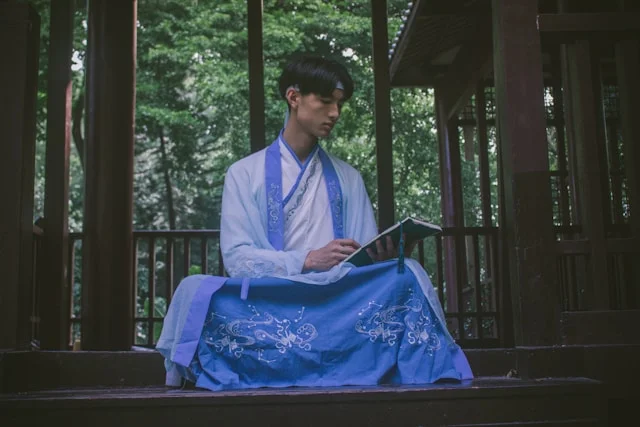
The male hanbok is built around two foundational pieces. The jeogori is the upper garment — a short, wrapped jacket that ties at the front using fabric ribbons called goreum. The baji is the lower garment — wide-legged trousers designed not to fit tightly but to drape with ease. According to the National Folk Museum of Korea, the baji features a drawstring called daenim at the ankles, allowing the wearer to adjust the fit for sitting on the floor, which was the standard posture in traditional Korean interiors.
These two pieces form the base layer. On top of the jeogori, men historically wore a baeja — a short, sleeveless vest — or a jokki, which is a buttoned version of the same. The outermost layer worn outdoors was the durumagi, a long overcoat that wraps closed and reaches near the ankles. The durumagi became the standard formal outerwear for men during the Joseon dynasty, replacing earlier styles like the jungchimak after the Gapsin Dress Reform of 1884.
One garment that is often left out of Western guides is the majoga, a long-sleeved jacket worn between the jokki vest and the durumagi. It matters for the layering order: baji and jeogori first, then jokki, then majoga, then durumagi. Get that sequence wrong and the silhouette does not read correctly. This layering logic is also why hanbok is always described as clothing worn from inner to outer — the visual beauty depends on seeing each layer settle correctly over the one beneath it.
How Color and Fabric Signaled Rank in Traditional Korean Male Clothing
Color in traditional Korean men’s clothing was not a personal preference. It was a social signal. The Ministry of Culture, Sports and Tourism of the Republic of Korea confirms that hanbok has maintained a consistent structure for approximately 5,000 years while varying significantly in color, fabric, and ornamentation according to the wearer’s age, social status, and occasion. That variation was the point.
Upper-class men — the yangban scholar-officials — wore hanbok in deeper, more saturated colors with embroidered details. Commoners wore muted, earthy tones and plain fabrics. White was particularly meaningful: for thousands of years many Koreans preferred white hanbok as a symbol of purity, and attempts during both the Joseon dynasty and the Japanese colonial period to discourage white clothing ultimately failed, according to Wikipedia’s documented history of hanbok. White remains the color most associated with mourning and ancestral rites, while red, blue, and gold appear in ceremonial and wedding contexts.
Fabric followed the same logic. Silk was reserved for the wealthy and for formal occasions. Hemp, ramie, and cotton were everyday materials for ordinary people. Ramie — an extremely fine, almost translucent weave — was prized for summer garments because of its breathability. The V&A notes that silk production in Korea dates to the neolithic period, with silk farming considered a highly skilled craft throughout Korean history. Knowing which fabric is appropriate for which occasion is as important as knowing the garment names.
Our take: If you are sourcing a men’s hanbok outside of Korea, pay close attention to fabric. Cheap polyester versions are widely available online and are fine for costume events. For a wedding, Chuseok celebration, or Seollal (Lunar New Year), choose silk or silk-blend versions from a specialist retailer. The difference in how the garment moves and reads is significant enough to justify the price difference.
Headwear and Accessories That Complete Traditional Korean Men’s Clothing
The gat is the accessory most people miss entirely. It is a hat made from bamboo or horsehair, semi-transparent, with a wide brim and a tall cylindrical crown. Only adult men of the Joseon ruling class wore it outside — it was not decorative in the Western sense but a status marker with strict social rules around its use. While you are unlikely to wear a gat in everyday life, recognizing it in historical imagery and museum collections matters for understanding how fully accessorized male hanbok worked as a total system.
Footwear also had its own code. The National Folk Museum of Korea identifies taesahye — shoes made from fabric or leather — as the traditional pairing for men’s hanbok. These are not sandals or slip-ons in the casual sense; they have a slightly upturned toe and a structured sole. Boseun, the white ankle socks worn beneath them, complete the look and were considered an essential part of a properly dressed appearance, not optional.
At the ankle, the baji includes the goreum string system that ties the trouser legs tightly before the boseun are pulled up over them. This detail is genuinely important for both aesthetics and practicality — it creates the clean, contained lower silhouette that makes men’s hanbok read as formal rather than casual. Skipping this step is the single most common mistake Western wearers make when putting on hanbok for the first time.
When and Why Men Wear Hanbok Today
Modern Koreans wear hanbok on specific occasions rather than daily. The core events are Seollal (Lunar New Year), Chuseok (the autumn harvest festival), hwangap celebrations marking a 61st birthday, weddings, and first birthday ceremonies known as dol. At a traditional Korean wedding, the groom wears a round-collared ceremonial robe — the gwanbok — with a silk winged hat called a samo. This is distinct from everyday hanbok and represents one of the more elaborate surviving forms of traditional Korean men’s clothing.
The South Korean government designated October 21st as Hanbok Day and has actively promoted a practice called hanbok saengwal — the wearing of hanbok in daily life rather than only at ceremonies. This effort has found genuine traction among younger Koreans, and it has a visible export in the form of modern hanbok, which blends traditional silhouettes with contemporary cuts and fabrics. Brands like Joteta (US-accessible) and Hyunmee Hanbok (UK-accessible) produce men’s modern hanbok that pair well with contemporary footwear and can be worn without the full layering system.
One honest trade-off worth knowing: modern hanbok for men is significantly easier to wear and source outside Korea, but it does sacrifice the full visual weight of the traditional layered system. A single-layer modern hanbok shirt worn with western trousers reads as culturally informed fashion. A full traditional set with durumagi and gat is a more complete cultural statement — but it requires more knowledge, more fitting attention, and usually a custom or specialist order. Neither is wrong. They are just different choices for different contexts.
Buying and Wearing Men’s Traditional Korean Clothes Outside Korea
Sourcing authentic or high-quality men’s hanbok in the USA and UK requires some care. Mass-market versions on large marketplace sites vary wildly in quality. For men who want a reliable, well-made set, Joteta ships internationally and offers both traditional and modern hanbok with accurate sizing charts for non-Korean body proportions. In the UK, Korean cultural organizations in London — particularly around New Malden, home to one of Europe’s largest Korean communities — often have connections to hanbok rental and purchase services for non-Korean buyers.
Sizing is the most common practical problem. Traditional hanbok sizing is based on height and weight rather than chest-waist-hip measurements. According to sizing guidance from specialist retailers, you should measure your height in centimeters and your weight in kilograms and cross-reference both against the provided chart. The baji is adjustable at the waist and ankle, which gives some flexibility, but the jeogori sleeve length needs to be correct for the goreum to tie properly at the front. When in doubt, size up rather than down.
Care is also worth planning before you buy. Silk hanbok should be dry-cleaned. Cotton and hemp versions can be hand-washed in cold water and laid flat to dry. Avoid machine washing any hanbok with embroidery or decorative goreum. Storing hanbok folded along its original seams rather than hanging it prevents stretching of the goreum ties and the wide baji panels.
Frequently Asked Questions
What is the difference between traditional and modern hanbok for men?
Traditional male hanbok follows the full historical layering system: baji, jeogori, baeja or jokki, majoga, and durumagi, often paired with boseun socks and taesahye shoes. Modern hanbok simplifies this — usually to a single top-and-trouser combination — and uses contemporary fabrics and cuts. Modern hanbok is designed to be worn in everyday or semi-formal settings, while traditional hanbok is reserved for ceremonies, festivals, and major life events. Both are valid forms of Korean traditional male clothing; the choice depends on context and how far you want to engage with the full layering tradition.
What colors are appropriate for men’s hanbok at a Korean wedding?
For a wedding ceremony, the groom traditionally wears deep jewel tones — navy, burgundy, or jade green — often combined with gold embroidery on a formal gwanbok robe. Male guests typically wear hanbok in blue, green, or grey tones. Red and bright orange are generally avoided by guests as these are associated with the bride or celebrant. White hanbok at a wedding carries mourning associations and is best avoided entirely unless you are certain of the specific family’s customs.
Is it disrespectful for non-Koreans to wear hanbok?
No — and this position is actively supported by the Korean government and Korean cultural organizations. The Korean Tourism Organization explicitly encourages visitors and non-Koreans to wear hanbok as a form of cultural appreciation. The distinction that matters is between respectful engagement and costume use: wearing hanbok at a Korean cultural event, festival, or ceremony with genuine interest is welcomed. Wearing it as part of a parody or without any cultural context is a different situation. For men in the USA or UK attending Korean cultural events or family occasions, wearing hanbok is considered a gesture of respect.
How do you tie the goreum ribbon on men’s hanbok correctly?
The goreum is the set of fabric ribbons that fastens the jeogori at the front. Both ribbons hang down from the collar. Cross the shorter ribbon over the longer one to form an X shape, then pass the shorter ribbon under the longer one to create a simple knot. Use the ribbon now on the left to form a loop, wrap the other ribbon around it, and tuck its folded center through the loop before pulling gently to tighten. The result should sit flat against the chest without puckering. Practicing this a few times before a formal event is strongly recommended — it looks simple but the tension and positioning take a moment to learn.
What fabric is best for men’s hanbok in a UK or US climate?
For autumn and winter events, a cotton-silk blend or medium-weight silk hanbok works well and layers over thermal undergarments without losing the silhouette. For summer events — outdoor festivals or Chuseok gatherings in warm weather — ramie is the historically accurate choice and remains genuinely breathable, though it can be harder to source. Linen is an acceptable modern substitute for ramie in warm climates. Avoid polyester for any formal occasion, as it does not drape correctly and the goreum ties often sit awkwardly on stiffer synthetic fabrics.
Final Thoughts
Korean traditional clothing for men is a complete system — not just a garment. Understanding the layering order, the color logic, the fabric choices, and the accessories is what separates wearing hanbok well from simply wearing hanbok. The garment has more than fifteen centuries of documented history, and that history is not abstract: it is visible in how the baji is cut, why the durumagi replaced earlier outerwear, and why white carries the specific cultural weight it does.
If you are ready to wear men’s traditional Korean clothing outside Korea, start by deciding whether a full traditional set or a modern hanbok better fits your occasion. For a ceremony or family event, invest in silk or silk-blend quality and take the time to learn the correct layering and goreum-tying sequence. For cultural events or everyday wear, a well-made modern hanbok set from a specialist retailer is the more practical starting point — and it is an honest representation of where Korean traditional men’s clothing stands today.


Leave feedback about this