

How the Advantages of Cobots Over Traditional Robots USA Are Changing Factory Floors
What Are Cobots?
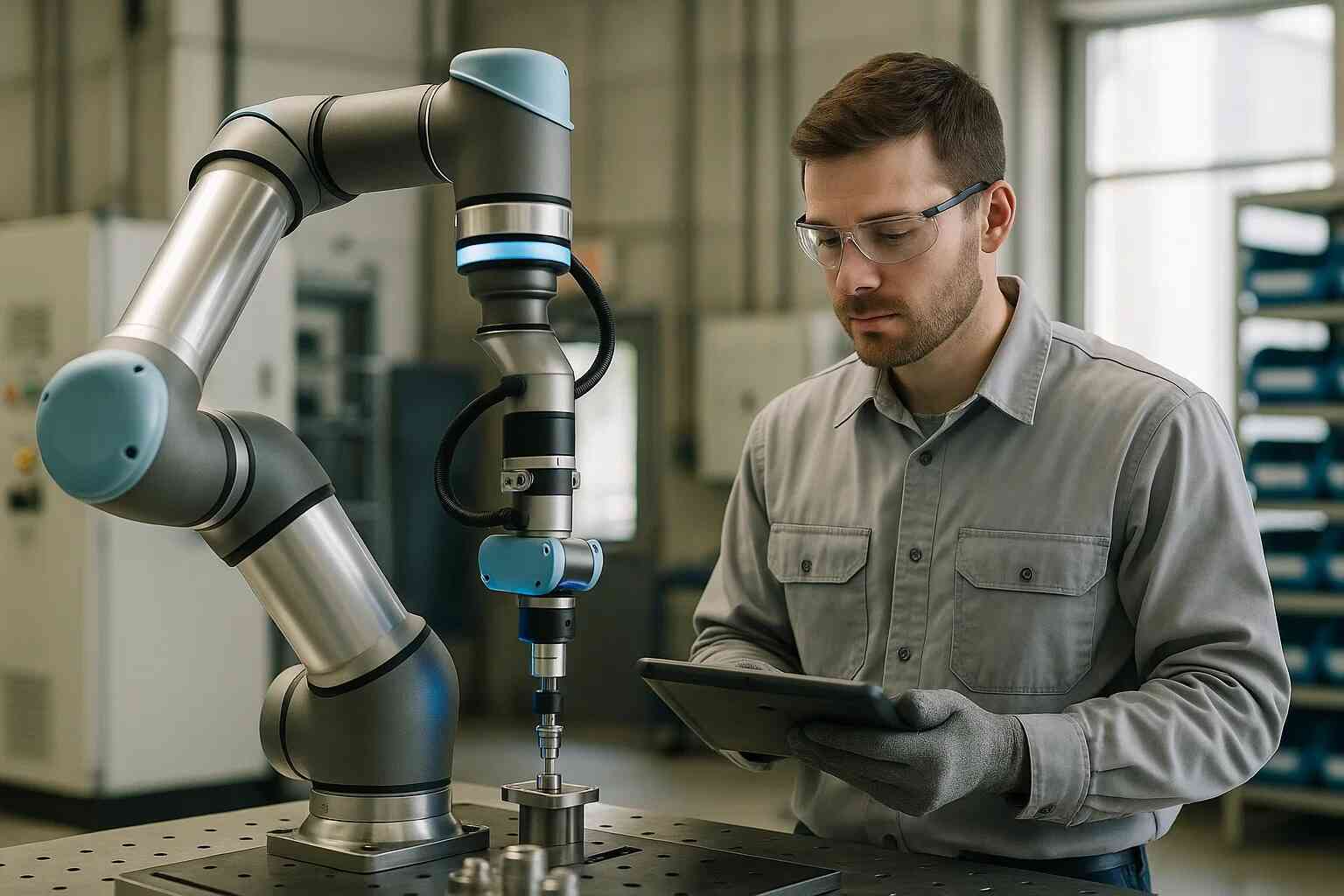
Collaborative robots, or cobots, are designed to work safely alongside humans without the need for extensive physical barriers. Unlike traditional industrial robots that operate in isolated cages, cobots share workspace with human operators and assist in repetitive or ergonomically challenging tasks.
Definition & Short History
The term cobot was coined in the late 1990s, but commercial adoption accelerated in the mid-2000s when companies like Universal Robots introduced user-friendly, lightweight arms. Today, cobots are transforming American manufacturing, labs, and logistics by offering automation that’s accessible to small and mid-sized enterprises (SMEs).
Core Technical Difference
Cobots differ from traditional robots mainly in power and force limiting, advanced sensors, and safe stop features. While traditional robots are fast and powerful but require isolation, cobots use torque sensors, vision systems, and built-in force limits to operate safely beside people.
Safety: Why Cobots Are Safer Around Humans
Safety is the defining advantage of cobots. Traditional industrial robots are fenced off due to high speed and force, while cobots are engineered for human-robot collaboration within shared workspaces.
ISO/TS 15066 & OSHA Guidance
In the USA, cobots must comply with ISO/TS 15066, the global safety specification for collaborative robotics. OSHA also mandates a risk assessment before deployment. This ensures that contact forces, tool hazards, and workspace layouts are within safe limits.
Real Safety Features
Modern cobots include force-limited joints, speed restriction zones, emergency stop functions, and collision detection. For example, Universal Robots’ UR series automatically stops when resistance exceeds safe thresholds. These built-in safeguards eliminate the need for cages in many applications while maintaining productivity.
Faster Deployment & Easier Programming
A key reason US factories favor cobots is their simplicity. Unlike traditional robots that require weeks of coding and integration, cobots can often be set up in a day or less.
Plug-and-Play Setup
Most cobots feature intuitive GUIs, drag-and-drop interfaces, and hand-guiding capabilities. Operators can teach movements simply by manually moving the arm. This reduces reliance on robotic engineers.
Deployment Timeline Example
A typical industrial robot might take 6–8 weeks for installation, programming, and safety validation. In contrast, a cobot can go from unboxing to operation in under 48 hours — a massive advantage for small US manufacturers needing rapid automation.
Lower Initial Cost & Improved ROI for SMEs
Traditional robotic cells are expensive due to fencing, guarding, and integration costs. Cobots dramatically reduce that burden.
Cost Comparison
| Category | Cobot System (USD) | Traditional Robot (USD) |
|---|---|---|
| Purchase & Setup | $25,000 – $45,000 | $80,000 – $150,000 |
| Safety Enclosures | None or minimal | $15,000 – $40,000 |
| Integration/Programming | $3,000 – $7,000 | $20,000 – $40,000 |
ROI Timeline:
Most US SMEs report ROI within 6–12 months, compared to 2–3 years for industrial robots. Lower maintenance and faster redeployment amplify savings.
Flexibility & Redeployability Across Tasks
Cobots thrive in dynamic production environments. When a job changes, they can be reprogrammed and reassigned within hours.
Tooling & End-Effector Swaps
Their modular design allows easy tool swaps — from grippers to screwdrivers or suction cups. This flexibility enables one cobot to serve multiple stations like packaging, palletizing, or quality inspection.
Practical Use Case
A small electronics factory in Ohio uses a single cobot on three production lines per week, thanks to its quick redeployment ability — something traditional robots can’t match without extensive reprogramming.
Space & Floorplan Advantages
Because cobots operate without fenced enclosures, they occupy minimal floor space — an often-overlooked cost factor in US facilities.
Before & After Example
Before: a 6-axis industrial arm required a 10×10 ft caged zone.
After: a cobot replaced it with a 3×3 ft footprint, freeing up 60% of workspace for operators and material flow.
This smaller footprint is ideal for urban factories, labs, and SMEs where every square foot counts.
Human Augmentation: Cobots as Workforce Multipliers
Cobots aren’t replacing people — they’re enhancing human productivity. By taking over dull, dirty, and dangerous tasks, cobots help workers focus on higher-value operations.
Tasks They Augment
Examples include packaging, machine tending, and testing — repetitive but precision-dependent jobs. Cobots relieve workers from strain and repetitive motion injuries.
Worker Well-Being & Reskilling
The Financial Times highlighted that cobots can improve mental well-being by reducing physical fatigue. However, companies should invest in reskilling programs to help operators manage and optimize these robots, promoting a human-robot partnership rather than displacement.
When Not to Pick a Cobot: Limits & Tradeoffs
Cobots aren’t perfect for every task. Understanding their limitations helps companies deploy them wisely.
Limitations
Cobots usually handle payloads under 15–20 kg and operate at slower speeds to maintain safety. For high-speed, heavy-duty operations (like car body welding or large palletizing), industrial robots remain superior.
Decision Matrix (Simplified)
| Use Case | Recommended Type |
|---|---|
| Precision assembly | Cobot |
| Heavy lifting (>25 kg) | Traditional Robot |
| High-speed packaging | Traditional Robot |
| Mixed human-robot workspace | Cobot |
| High accuracy lab work | Cobot |
US Regulatory & Safety Checklist
A practical checklist for cobot deployment in the United States includes the following key steps:
Risk Assessment — required under OSHA 29 CFR 1910.212.
ISO/TS 15066 Compliance — verify contact force and speed limits.
ANSI/RIA R15.06 & R15.806 Documentation — for robotic system safety.
Emergency Stop Verification — test E-stop and safety circuit integration.
Operator Training — ensure awareness of cobot limits and safe zones.
These actions not only ensure safety but also support compliance during OSHA inspections.
Real US Case Studies
1. Electronics Assembly – Texas
A small electronics firm integrated two cobots for soldering and testing. Result: labor costs dropped by 25%, and throughput rose 18% within four months.
2. Packaging Line – Illinois
A food processor deployed cobots for packaging. Result: zero safety incidents in a year, with a 35% reduction in downtime.
3. Medical Lab – California
Cobots now assist with pipetting and labeling. Result: saved 12 hours per week of technician time and improved consistency by 20%.
Costs, Maintenance & Lifecycle (TCO)
Cobots typically have lifespans of 8–10 years with minimal maintenance.
Maintenance Tasks
- Lubrication and joint inspection every 6 months.
- Firmware updates via vendor portal.
- Sensor calibration annually.
Cobots have Mean Time Between Failures (MTBF) around 35,000–40,000 hours, with vendor warranties covering 2–3 years.
Pros & Cons of Cobots vs Traditional Robots
Pros of Cobots
- Lower cost and faster ROI.
- Safer, cage-free operation.
- Easy to program and redeploy.
- Compact and space-efficient.
- Boost worker morale and flexibility.
Cons of Cobots
- Limited speed and payload.
- Not ideal for large-scale heavy tasks.
- Require human supervision.
- Sensitive to environmental factors like dust and vibration.
Quick Guide:
Choose a cobot if your goal is flexible automation with human collaboration.
Choose a traditional robot if you need high throughput or heavy lifting.
FAQ
Are cobots safe enough to replace cages?
Yes. Cobots are designed with force-limiting technology that stops motion when resistance is detected. Compliance with ISO/TS 15066 ensures safety without cages in most cases.
How much does a cobot cost to install in the USA?
Typical cobot systems cost $30,000–$60,000, including setup. This is far cheaper than traditional robotic cells, which often exceed $100,000.
What jobs can cobots not do?
Cobots struggle with heavy lifting, high-speed welding, or hazardous chemical handling — these remain the domain of industrial robots.
Do cobots require special training?
Basic training (2–3 days) is sufficient. Most vendors, like Universal Robots, provide certified online and on-site courses for operators.
How to perform a cobot ROI calculation?
Add total investment (purchase + integration) and divide by annual labor savings. Example: $40,000 cost ÷ $80,000 yearly savings = 0.5 years ROI.
Are cobots suitable for small US factories?
Absolutely. SMEs benefit most from cobots due to their affordability, flexibility, and ease of use in compact spaces.
Conclusion
Cobots have reshaped automation in the United States by offering safe, cost-effective, and flexible alternatives to traditional industrial robots. For SMEs and growing manufacturers, they provide rapid deployment, smaller footprints, and faster ROI — all while supporting human workers rather than replacing them.
Before investing, companies should assess their payload needs, safety standards (OSHA, ISO/TS 15066), and workforce readiness. The smartest approach: start with a pilot deployment, track performance gains, and scale gradually.
In 2025 and beyond, the advantages of cobots over traditional robots in the USA make them the go-to choice for agile, future-ready factories.





Leave feedback about this