

Mike Wolfe Passion Projects: Reviving Americana and Small-Town Heritage
Introduction
When Mike Wolfe walked into a dusty barn on an episode of American Pickers, most saw “old junk.” Wolfe saw fragments of America’s story: rusted signage, vintage bikes, forgotten barns. What began as treasure-hunting in barns evolved into something far more significant. Today Wolfe is as much a storyteller and community revitaliser as he is a TV personality. In 2025, his mission has transitioned from simply collecting objects to preserving spaces, reinvigorating towns, and championing small-town America. This article examines Wolfe’s passion projects, his philosophy of preservation, and how his work is shaping communities in 2025.
Who Is Mike Wolfe? The Collector, Historian & Passion-Driven Preservationist
Before he became a household name via the History Channel show American Pickers, Mike Wolfe nurtured a fascination with America’s vanished roadsides, the roadside gas stations, the motor-era neon signs, and the motorcycles that once roared down two-lane highways. He didn’t simply collect “things.” He treated these artifacts as fragments of a larger story: of towns, of manufacturing, of human endeavour.
Wolfe’s early perception was this: what many see as junk is actually legacy in disguise. A rusted sign isn’t worthless—it’s a marker of an era. A vintage gas pump isn’t just a piece of metal—it’s part of the infrastructure of American mobility. That mindset continues to inform his work in 2025. He remains a collector, yes—but more importantly a historian, restorer, and champion of place.
From Picker to Preservationist: A Vision Evolves
For years, Wolfe’s public profile was as a “picker”: the guy who goes into barns and warehouses in search of treasures. But over time the focus shifted. Instead of only salvaging objects, he turned his attention to the spaces in which those objects, those stories, once lived.
Why the shift? Several factors:
- Emotional connection: He began seeing that the buildings and places themselves held stories—sometimes even more powerfully than individual objects.
- A sense of urgency: With many small-town buildings being demolished or neglected, he felt compelled to save those physical spaces.
- Bigger impact: Restoring a building or a town creates ripple effects—community pride, economic stimulus, heritage tourism—beyond the immediate salvage of an item.
By 2025, the vision is clear: to revitalise forgotten buildings with modern purpose*, while retaining historic character.
The Columbia, Tennessee Revitalisation Project
One of the most visible manifestations of this vision is in Columbia, Tennessee (in Maury County, Tennessee). Here are key updates and highlights for 2025:
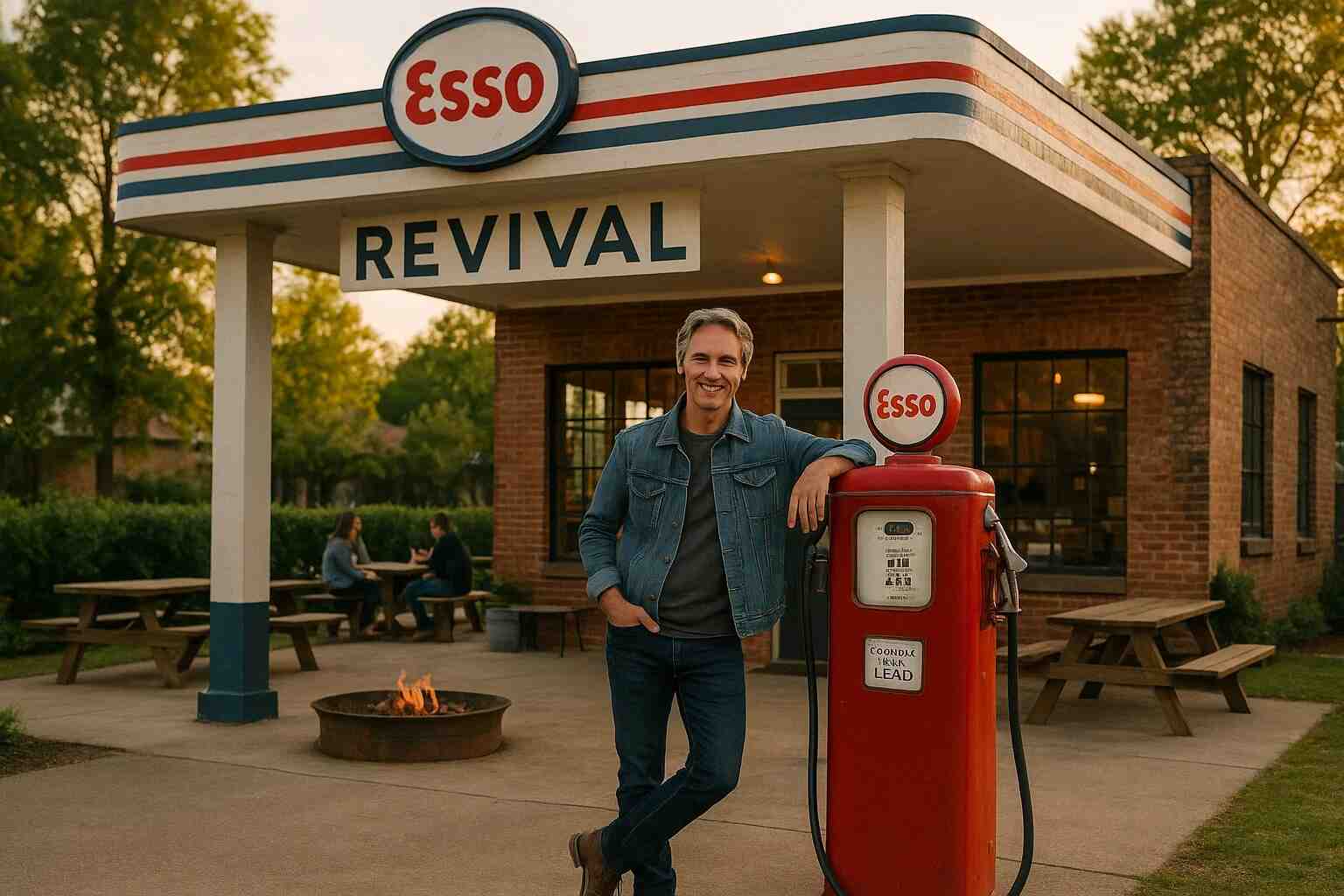
- Wolfe acquired a late-1940s Esso service station in downtown Columbia and has restored it into a space named Revival—complete with outdoor seating, fire pit, stage, pergola, and neon signage that nods to the original era.
- A wine bar concept under the “Revival” brand is planned for opening in June 2025.
- Wolfe has also been renovating other buildings in Columbia: a historic 1873 Italianate mansion (cupola restoration, tower work) and the 1947 Chevy dealership-turned-cultural space called Columbia Motor Alley.
- The broader downtown district is showing measurable investment: According to the local Main Street programme, for 2024 the district saw 31 building rehabilitation projects, $53.5 million in private investment, 81+ jobs created, and an 8 % vacancy rate.
Why this matters
- Historic integrity & authenticity: The Revival project preserves the character of a 1940s gas station, embedding vintage pumps, neon signage, and outdoor gathering areas rather than demolishing and replacing.
- Community gathering: The space is meant to serve locals as well as visitors — a transformation of a utilitarian old service station into a social hub.
- Economic uplift: Through such projects, more foot traffic, more tourism, more new business opportunities emerge in downtown Columbia.
- Sustainability & reuse: Instead of new builds that erase history, adaptive reuse of old structures reduces waste and preserves embodied architectural value.
Challenges & Criticisms
- Some inspection and permit issues delayed full utilisation of the space. For instance, the fire & gas inspection for the former winery-turned-outdoor venue failed at one point.
- While many community members welcome the revitalisation, others express concerns about change, housing costs, and preserving local “small-town character.”
- Not all elements (like the interior restaurant concept) have been finalised; some spaces remain unused or in flux as of early 2025.
Two Lanes: A Love Letter to Americana
Beyond bricks and mortar, Wolfe’s brand Two Lanes embodies his ethos: celebrating small-town roads, back-road Americana, craft, and heritage.
- The brand curates stories of off-the-beaten-path America: the craftsmen, photographers, artisans who maintain tradition.
- Merchandise under Two Lanes emphasises “American-made” goods, supporting local economies and craftsmanship.
- Wolfe integrates his lifelong passion for vintage motorcycles (especially Indian and Harley-Davidson models) into the Two Lanes narrative: these bikes represent freedom, adventure, and the pioneering spirit of America.
- Through the brand and associated guesthouses or BMW-style retreats, he offers experiential dimensions rather than mere retail.
In 2025, Two Lanes functions as a digital and physical extension of his restoration mission: tangible objects, online community stories, and the interplay of heritage, place, and commerce.
Partnerships, Craftsmen & the Importance of Local Engagement
Wolfe’s work isn’t a solo mission—it involves collaboration:
- He works with design firms like Living Exo to interpret his vision for adaptive-reuse projects and ensure the historic feel is respected.
- He emphasises employing local craftsmen—masons, woodworkers, metal-workers—in his projects. This preserves artisanal techniques and invests in the local economy.
- He encourages partnerships with municipal programmes (e.g., the Columbia Main Street organisation) and leverages heritage and economic development policies to fuel progress.
The result is a model: preservation that is not nostalgic but active, rooted in community, locally anchored, and future-oriented.
The Wider Significance: Why Historic Preservation Matters in 2025
In an era of rapid change—urban sprawl, remote work, supply-chain disruption, shifting demographics—the preservation of older buildings and small-town main streets becomes increasingly relevant. Wolfe’s work highlights several broad themes:
- Sustainability: Re-using existing structures avoids demolition-waste, leverages embodied energy, and can be more eco-efficient than new builds.
- Cultural continuity: Historic buildings anchor local identity, reminding communities of their past and giving them a sense of rootedness.
- Economic revitalisation: Historic districts often draw tourism, encourage new business formation, and stimulate property investment (as seen in Columbia: 81+ new jobs, $84 + million in investment).
- Educational value: Younger generations get to see craftsmanship, architectural detail, and storytelling embedded in built form—rather than just generic modern developments.
- Community cohesion: When locals reclaim and preserve their built environment, it strengthens civic pride and social bonds.
In short: Wolfe’s projects are more than aesthetic—they are socially, economically and environmentally meaningful.
What’s Next for Mike Wolfe in 2025 and Beyond
Here are some of the key developments and likely directions for Wolfe going forward:
- Wolfe announced the closure of his Antique Archaeology—Nashville store in April 2025 after nearly 15 years, signalling a refocus of his efforts.
- He may replicate his “Revival” model in other small towns beyond Columbia, leveraging the playbook of historic building restoration + mixed-use activation.
- He is reportedly developing additional television or documentary projects focused on restoration and heritage rather than just picking antiques.
- He continues to invest in small-town buildings, guest-houses (Two Lanes Guesthouse), and motorcycle culture, blending tourism, hospitality, and restoration.
- He will likely continue to build collaborations with town programmes, historic preservation bodies, and local artisans.
Pros & Cons of the Mike Wolfe Approach
Pros
- Revives local heritage and gives communities renewed pride.
- Stimulates local economies, tourism and small business development.
- Promotes sustainability by adapting and re-using historic structures.
- Encourages appreciation of craftsmanship, history and depth beyond surface aesthetics.
Cons
- Restoration can be expensive and complex: hidden structural issues, permit delays, inspection failures (as seen with his Columbia gas station project).
- Projects can take a long time to become fully functional and profitable; the payoff is often social/cultural as well as financial.
- There can be community resistance: some locals feel the change may threaten affordability or alter small-town character.
- Maintenance of restored historic properties requires ongoing commitment and cost.
Frequently Asked Questions (FAQ)
Q1. Where exactly is Wolfe’s major passion project located?
A1. The flagship project is the restored 1940s Esso service station in downtown Columbia, Tennessee, under the Revival brand.
Q2. What is the current use of Revival?
A2. It is being transformed into a wine bar / social-space (opening planned for June 2025) with outdoor seating, pergola, fire pit and live-music stage.
Q3. Is the project featured on American Pickers?
A3. While Wolfe’s TV show remains active, this specific project has not been fully integrated as a major episode narrative yet, though his social-media posts and news features cover it.
Q4. Why did Mike Wolfe emphasise old buildings over new construction?
A4. Wolfe believes that historic buildings hold stories, human labour and regional character. Preserving them links past and future, rather than erasing history for generic modernity.
Conclusion
Mike Wolfe’s journey—from searching through barns on American Pickers to restoring town districts in Columbia, Tennessee—is not simply a career trajectory. It’s a redefinition: the “picker” becomes the preservationist, the storyteller becomes the community builder, and the antiques collector becomes the heritage revivalist. What’s at stake is more than architecture: it’s identity, memory, place, and sustainability.
In 2025, his work offers a model: build with history in mind, activate buildings with community purpose, and let heritage fuel regeneration rather than stagnation. The real ROI isn’t just profit—it’s the renewed pulse of a small town, the revived character of a downtown block, the next generation recognizing that history isn’t something to hide—it’s something to live in.
How do you feel about preserving old buildings in your own community? Do you see value in adaptive-reuse projects like these, or are there risks you’re concerned about? I’d love to hear your thoughts.
K&K Jewelry: A Buyer’s Guide to Custom Designs, Bridal Rings, and Online Shops




Leave feedback about this