

Traditional Canadian Outfit: What Canadians Wore Then and How It’s Seen Today
When people from the US or the UK think of Canada, they often picture a Mountie in a bright red jacket or perhaps someone bundled up in fur against a snowy backdrop. While those images aren’t wrong, they barely scratch the surface of what a true traditional Canadian outfit actually looks like.
Canada is a massive country with diverse geography and an equally diverse history. From the frozen Arctic to the rugged coasts and sweeping prairies, the clothing developed here was rarely just about fashion—it was about survival. But beyond utility, these garments tell the stories of the people who made them.
Unlike some countries with a single, unified national dress (like the kilt in Scotland or the kimono in Japan), Canada doesn’t have one specific outfit that represents every citizen. Instead, it boasts a rich tapestry of styles influenced by Indigenous ingenuity, French and British colonial history, and the unique Métis culture that bridges these worlds.
In this guide, we are going to explore the history, meaning, and modern relevance of these garments. We will look at how geography shaped design and how these traditional styles are still celebrated today. Whether you are a culture enthusiast or just curious about your northern neighbors, let’s dive into the fascinating world of Canadian heritage fashion.
What Is a Traditional Canadian Outfit?
Defining a traditional Canadian outfit is tricky because Canada isn’t a monoculture. It is a nation built on the lands of hundreds of distinct First Nations and Inuit communities, followed by waves of European settlers. Therefore, “traditional” varies wildly depending on where you are standing on the map.
If you are in the far north, tradition looks like complex layers of caribou hide and seal skin designed to withstand -40°F temperatures. If you are in Quebec, it might look like the ceinture fléchée (arrow sash) worn by early voyagers during the fur trade era. On the West Coast, cedar bark clothing was traditionally significant.
The reason Canada lacks one fixed national dress comes down to two main factors: climate and cultural diversity. A wool outfit suitable for a damp Nova Scotia winter would be useless—and dangerous—in an Arctic blizzard. Clothing had to be hyper-localized to be effective.
Furthermore, the concept of a “national costume” is often a European invention used for nation-building. Canada’s identity is more of a mosaic. When we talk about traditional clothing here, we are acknowledging a collection of distinct regional and cultural wardrobes rather than a single uniform.
Why Canada Has Multiple Traditional Styles
The sheer size of the country dictates diversity. Indigenous groups in the Pacific Northwest had access to different resources than the Plains Cree or the Inuit in Nunavut. When settlers arrived, they brought French textiles and Scottish wools, which then mixed with Indigenous designs to create new hybrids. This blend created a wardrobe that is functional, historical, and incredibly varied.
Traditional Outfit vs Modern Canadian Clothing
It is important to distinguish between historical dress and what Canadians wear today. You won’t see people walking down the streets of Toronto or Vancouver in full regalia or fur-lined parkas unless it is a specific cultural event or a brutally cold day where modern versions of these items are necessary. Today, “traditional” often refers to ceremonial wear, while modern Canadian style prioritizes high-tech winter gear that owes a lot to those original designs.
Indigenous Traditional Canadian Clothing
The foundation of the traditional Canadian outfit lies with Indigenous peoples—the First Nations, Inuit, and Métis. For thousands of years before European contact, these communities crafted clothing that was perfectly adapted to their environments. This wasn’t just clothing; it was survival technology, often far superior to anything European explorers brought with them.
Indigenous clothing is deeply spiritual and practical. Every material used—whether it be moose hide, caribou skin, seal fur, or cedar bark—was harvested with respect and gratitude to the animal or plant. The preparation of hides and the sewing of garments were highly skilled arts passed down through generations, usually among women.
The decoration of these garments is equally important. Beadwork, quillwork (using dyed porcupine quills), and embroidery tell stories of family lineage, spiritual beliefs, and personal identity. A jacket wasn’t just a jacket; it was a canvas displaying who the wearer was and where they came from.
Inuit Traditional Parkas and Amauti
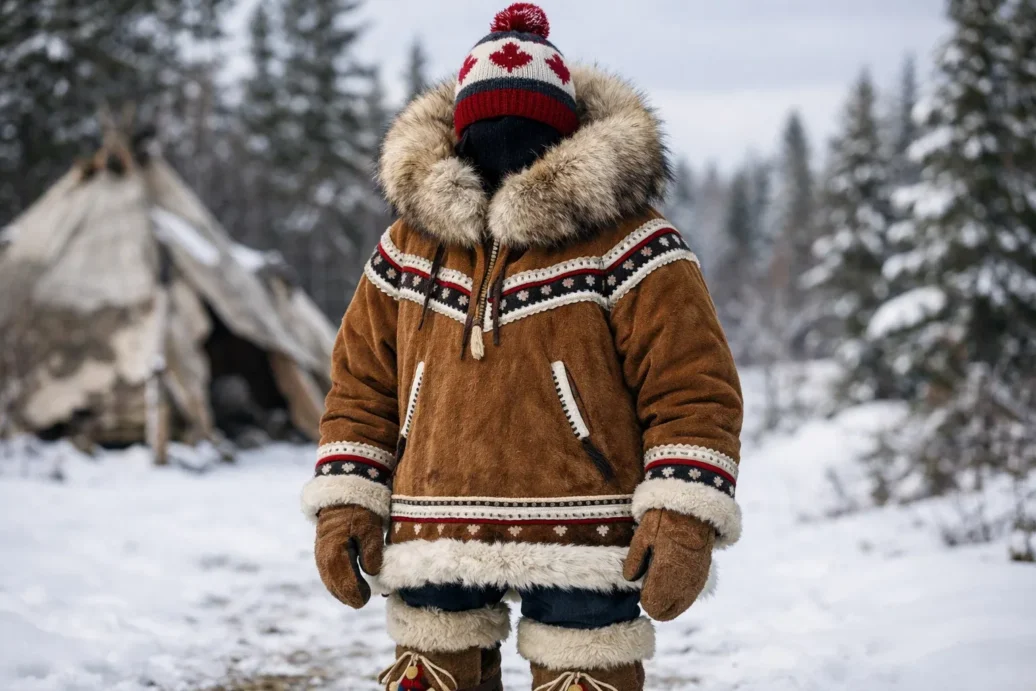
In the Arctic, the Inuit developed some of the most sophisticated cold-weather clothing in human history. The amauti is a parka worn by Inuit women, designed with a built-in pouch on the back to carry a baby against the mother’s warm skin. It is a masterpiece of engineering, allowing the mother to share body heat while keeping her hands free. These garments are traditionally made from caribou or seal skin, chosen for their incredible insulating properties and water resistance.
First Nations Clothing and Symbolism
First Nations groups across Canada had distinct styles. On the Plains, clothing was often made from elk or bison hides, decorated with intricate beadwork or quillwork. Moccasins—soft leather footwear—are perhaps the most universal element, though the cut and decoration vary by tribe. On the Northwest Coast, button blankets (wool blankets decorated with pearl buttons and clan crests) became a striking form of ceremonial dress after trade was established. Each piece serves a purpose, balancing physical protection with spiritual expression.
The Role of Climate in Traditional Canadian Outfits
You cannot discuss any traditional Canadian outfit without discussing the weather. Canada is famous for its winters, and for good reason. Historically, a poorly made coat wasn’t just uncomfortable; it was a death sentence. This harsh reality shaped every seam, stitch, and material choice in Canadian heritage clothing.
The extreme cold necessitated layers. Long before the modern “three-layer system” of base, mid, and shell layers became popular in outdoor retail, Indigenous peoples were using the same principle. They utilized inner layers of fur facing the skin for trapped heat and outer layers of durable hide to block the wind.
This survival-based design philosophy heavily influenced European settlers. When French and British explorers arrived, they quickly realized their linen and wool clothing was insufficient for the Canadian wilderness. They adopted Indigenous methods, wearing moccasins and fur-lined coats to survive. This adaptation is a key feature of Canadian clothing history—it is a story of borrowing and refining survival gear.
Arctic vs Southern Canada Clothing Differences
The difference in clothing between the Arctic and the southern border is stark. In the North, the priority is retaining heat and preventing sweat from freezing. Inuit clothing is designed to “breathe” to manage moisture. In the milder (but still cold) south, dampness is the enemy. Wet snow and rain required materials that could repel water, leading to the use of oiled leather and tightly woven wools in settler communities.
Functional Design in Traditional Wear
Function always dictated form. For example, the fringes often seen on buckskin jackets weren’t just for decoration. They served a practical purpose: they helped shed rain and snow so the garment would dry faster. If a piece of leather got soaked, it would freeze stiff. Fringes acted as a drainage system. Similarly, the long hoods on parkas were designed to create a tunnel of warm air around the face, protecting the skin from frostbite without obstructing vision.
Métis Traditional Outfit and the Famous Sash
The Métis people, who are of mixed Indigenous and European ancestry, possess a distinct culture that beautifully bridges two worlds. Their traditional clothing reflects this fusion, creating a unique style that is instantly recognizable in Canadian history. The most iconic element of the Métis wardrobe is undoubtedly the sash, or ceinture fléchée.
The Métis were central to the fur trade, working as voyagers, traders, and interpreters. Their clothing had to be rugged, versatile, and warm. They often combined European cuts of clothing with Indigenous materials, wearing buckskin jackets alongside woven wool items. This hybrid style became a symbol of their unique identity as a distinct people.
While the Métis outfit often includes beaded vests, moccasins, and ribbon skirts (for women), the sash remains the centerpiece. It serves as a visual identifier of Métis culture at festivals and political gatherings today.
Meaning of the Métis Sash
The ceinture fléchée is a finger-woven sash made of wool. Historically, it was much more than an accessory. It was a multi-tool for the voyager. It could be used as a rope, a tumpline to carry heavy fur packs, a washcloth, a towel, or even an emergency sewing kit (by pulling out threads). The colors and patterns often represented different families or communities, acting similarly to a Scottish clan tartan.
When and How It Is Traditionally Worn
Men traditionally wore the sash tied around the waist of a coat (often a Hudson’s Bay point blanket coat). Today, it is worn ceremonially by both men and women. Men typically wear it around the waist, while women often drape it over one shoulder and pin it at the opposite hip. It is a mandatory accessory at Métis cultural events and serves as a powerful symbol of resilience and nationhood.
European Influence on Traditional Canadian Clothing
As French and British settlers established colonies in Canada, they brought their own fashion traditions, which inevitably clashed with—and then adapted to—the reality of the Canadian landscape. The European influence on the traditional Canadian outfit is most visible in the use of wool and tailored garments.
The French settlers, or Habitants, developed a distinct rural style in Quebec. They relied heavily on homespun wool because sheep could be raised on farms. However, they quickly adopted elements of Indigenous dress, such as moccasins and fur caps, to cope with the deep snow. This blend created a “Canadien” look that was distinct from what people were wearing back in Paris or London.
British influence brought different textiles, specifically tartans and heavy tweeds. The fur trade companies, like the Hudson’s Bay Company, played a massive role here by importing wool point blankets. These blankets were traded to Indigenous peoples and settlers alike, eventually being sewn into the iconic “capote”—a hooded coat that became a staple of the Canadian winter wardrobe.
French-Canadian Clothing Traditions
A classic image of a traditional French-Canadian outfit involves the tuque (a knit cap), a heavy wool coat, and the arrow sash tied at the waist. Trousers were often tucked into high boots or leggings to keep the snow out. This outfit was practical for logging, farming, and trapping. The “tuque” itself has become a national symbol, worn by almost every Canadian today, regardless of heritage.
Scottish and British Elements
The Scottish influence is particularly strong in the Atlantic provinces (Nova Scotia literally means “New Scotland”). Kilts and tartans are part of the regional heritage, but they were adapted for the cold. Wool was essential. The heavy wool coats used by the British military and settlers evolved into garments like the Mackinaw jacket—a dense, water-resistant wool coat that is still a staple of Canadian workwear today.
Iconic Traditional Canadian Outfits
When we look for a recognizable “national” look, two specific images usually come to mind: the Royal Canadian Mounted Police (RCMP) in their Red Serge and the Hudson’s Bay stripes. These are the visuals most often associated with a traditional Canadian outfit by the outside world.
While everyday Canadians do not walk around in scarlet tunics, these outfits hold significant ceremonial value. They represent the history of the state and the colonial era. However, it is important to view them as uniforms or heritage brands rather than “folk dress” in the anthropological sense.
These iconic looks are heavily marketed in tourism, appearing on everything from postcards to syrup bottles. But they do have roots in genuine history. The Red Serge, for instance, traces back to the North-West Mounted Police in the 1870s, modeled after British military uniforms but adapted for the frontier.
RCMP Red Serge – A National Symbol
The RCMP dress uniform consists of the scarlet tunic, midnight blue breeches with a yellow stripe, high brown leather boots (strathcona boots), and the wide-brimmed Stetson hat. It is technically a military-style uniform, but it has become the de facto “costume” of Canada on the world stage. You will see this outfit at state funerals, royal visits, and the famous Musical Ride performance.
Tartan and Heritage Dress in Canada
Did you know Canada has an official national tartan? It is the Maple Leaf Tartan, designed in 1964. The colors reflect the changing seasons of the maple leaf: green, gold, red, and brown. While not an ancient “outfit,” wearing this tartan is a way many Canadians express patriotism and connection to British heritage. It is often seen in scarves, ties, and shawls during national holidays.
Traditional Canadian Accessories
Sometimes, the accessories define the outfit. In the case of the traditional Canadian outfit, accessories were critical for protecting the extremities from frostbite. You could have the warmest coat in the world, but without proper headgear, gloves, and footwear, you wouldn’t survive a winter night outdoors.
These items have transcended their historical roots to become everyday essentials for modern Canadians. While the materials have changed—synthetic fleece often replaces wool or fur—the designs remain strikingly similar to their ancestors.
The most famous of these is the toque (rhymes with “duke”). Known as a beanie in other parts of the world, in Canada, it is strictly a toque. It is historically a tightly knit wool cap worn by voyageurs and fur traders.
The History of the Canadian Toque
The toque has French origins but became a universal Canadian item. Early versions were long and tapered, sometimes with a tassel, and were often double-layered to trap heat. Today, wearing a toque is a rite of passage. It is one of the few items of “traditional” clothing that is universally worn by bankers, students, and construction workers alike from October to April.
Traditional Footwear and Winter Gear
Mukluks and moccasins are the superstars of traditional Canadian footwear. Moccasins are soft leather shoes, ideal for summer or indoor wear. Mukluks are high-boot versions designed for winter, often lined with fur and featuring rugged soles. They are incredibly warm and lightweight compared to heavy European leather boots. Mittens were also preferred over gloves historically because keeping fingers together generates more warmth. Traditional mittens were often made of smoked moose hide and lined with wool or fur.
How Traditional Canadian Outfits Are Worn Today
You might be wondering, “Do people still wear this stuff?” The answer is yes, but context matters. You won’t typically see a full buckskin outfit or a Red Serge uniform at the grocery store. However, elements of the traditional Canadian outfit are alive and well in modern fashion and cultural life.
There has been a massive resurgence in Indigenous fashion. Indigenous designers are reclaiming traditional styles—like beadwork, ribbon skirts, and mukluks—and blending them with contemporary streetwear. This isn’t just “costume”; it is high fashion. Brands like Manitobah Mukluks have brought traditional footwear into mainstream global markets.
For non-Indigenous Canadians, “traditional” wear often comes out during winter festivals. Events like the Quebec Winter Carnival see thousands of people donning arrow sashes and red toques. It is a way to celebrate heritage and have fun with history.
Traditional Clothing in Festivals and Events
During powwows, First Nations dancers wear intricate regalia. We use the word “regalia,” not “costume,” because these outfits have spiritual significance and are often handmade by the dancer or their family. Similarly, on Louis Riel Day, you will see the Métis sash displayed prominently. Highland games in the Maritimes bring out the kilts. These events are where the full traditional outfits shine.
Mixing Traditional Pieces with Modern Fashion
For daily wear, it’s about hybridization. A modern Canadian might wear jeans and a parka (inspired by Inuit design) paired with genuine leather mukluks and a toque. Cowichan sweaters—heavy, hand-knit wool sweaters from the Coast Salish people of British Columbia—are another prime example. They are expensive, prized items worn as everyday outerwear, bridging the gap between artifact and apparel.
Cultural Respect and Traditional Outfits
In an era of globalization, it is vital to discuss cultural appropriation versus appreciation. Traditional clothing, especially Indigenous regalia, is not a Halloween costume. It holds deep meaning, often connected to earned status, spiritual beliefs, or family history.
When visitors or non-Indigenous Canadians are interested in the traditional Canadian outfit, the key is respect. Buying authentic goods from Indigenous artisans is a form of appreciation. It supports the economy and keeps the art forms alive. However, wearing a cheap, mass-produced imitation of a headdress or sacred item is considered highly offensive.
Understanding the difference between a “souvenir” and a “sacred object” is crucial. Moccasins and mukluks are generally meant to be shared and worn by everyone. A ceremonial headdress or specific spirit masks are not.
When It’s Appropriate to Wear Traditional Clothing
If you buy a Cowichan sweater or a pair of mukluks from a verified Indigenous artist, please wear them! The artists create these items to be worn and enjoyed. Wearing a Métis sash if you are not Métis can be more complex; it is often better to ask local community members or wear it in a way that shows support rather than claiming identity.
Respecting Indigenous Traditions
The best rule of thumb is to educate yourself on the source. Is the item authentic? Does the seller have permission from the community to sell these designs? True traditional clothing is about storytelling. By wearing authentic pieces responsibly, you help tell the story of the artist and their culture, rather than erasing it with a cheap knockoff.
Pros and Cons of Traditional Canadian Outfits
Like any form of clothing, traditional Canadian garments have their strengths and weaknesses. They were designed for a specific time, place, and purpose. Understanding this helps us appreciate why we still wear some items while others have been relegated to museums.
The primary advantage of these outfits is their performance in the cold. Natural materials like fur, wool, and leather are breathable and insulating in ways that some synthetic fabrics still struggle to match. However, they require maintenance and care that doesn’t fit easily into a modern, fast-paced lifestyle.
Pros
- Cultural Identity: Wearing these items connects people to their ancestors and preserves history.
- Superior Protection: A traditional Inuit parka is arguably warmer than many high-end commercial jackets.
- Craftsmanship: These are handmade items, built to last for decades, reducing waste.
- Natural Materials: Most traditional clothing is biodegradable and sustainable.
Cons
- Maintenance: Leather and fur require specific care and cannot just be thrown in a washing machine.
- Cost: Authentic handmade items are expensive due to the labor and materials involved.
- Ethics: The use of real fur is controversial for many people today, though it remains a subsistence reality for many Northern communities.
- Practicality: Full traditional regalia is heavy and cumbersome for driving a car or sitting in an office.
Common Myths About Traditional Canadian Clothing
There are plenty of misconceptions floating around about what Canadians wear. Let’s clear up a few of the biggest myths regarding the traditional Canadian outfit.
One of the most persistent myths is that everyone in Canada walks around in fur trapper hats. While you’ll definitely see them in rural areas or during extreme cold snaps, they aren’t the standard urban uniform.
Another myth is that Canada has “no culture” or traditional dress. As we’ve explored, the opposite is true—we have too many traditions to pick just one.
“Canada has no traditional clothing”
This is false. It stems from looking for a single European-style “peasant costume” that represents the whole nation. Canada’s traditions are regional. The lack of one uniform is actually a testament to the country’s diversity.
“Only Indigenous people have traditional outfits”
While Indigenous clothing is the foundation of Canadian dress, settler communities (French, Scottish, Ukrainian, etc.) also maintained traditional styles that evolved in Canada. The “Canadien” voyageur look is a distinct, historical settler outfit.
Conclusion
The traditional Canadian outfit is not a single garment hanging in a museum. It is a vibrant, living collection of styles that tell the story of survival, adaptation, and cultural blending. From the ingenious engineering of the Inuit parka to the symbolic weave of the Métis sash and the iconic red of the RCMP, these outfits paint a picture of a complex nation.
While you might not see these full outfits on the street every day, their influence is everywhere. Every time you pull on a toque, lace up winter boots, or wear a layered wool coat, you are participating in a lineage of clothing designed to conquer the North.
We hope this guide has given you a deeper appreciation for Canadian heritage fashion. Whether you are looking to buy authentic mukluks or just wanted to understand the history behind the Red Serge, remember that these garments are more than just fabric—they are history you can wear.
FAQ Section
What is considered a traditional Canadian outfit?
There isn’t one single outfit. However, iconic examples include Indigenous clothing like parkas and mukluks, the Métis sash, French-Canadian voyageur clothing (wool coats and toques), and the ceremonial RCMP Red Serge uniform.
Do Canadians still wear traditional clothing today?
Yes, but usually in specific contexts. Indigenous peoples wear regalia for ceremonies and powwows. Elements like mukluks, cowichan sweaters, and toques are worn daily as functional winter wear. Full historical outfits are mostly seen at festivals or museums.
What is the most famous traditional Canadian outfit?
Globally, the Royal Canadian Mounted Police (RCMP) Red Serge is the most recognized symbol. Culturally, the Inuit parka and the Métis sash are deeply significant and widely recognized within Canada.
What is the Métis sash used for?
Historically, it was a tool used by voyageurs as a back support, rope, washcloth, and towel. Today, it is a ceremonial item worn to represent Métis culture, pride, and identity.
Is it respectful for non-Canadians to wear traditional outfits?
It depends on the item. Wearing a “costume” version of Indigenous regalia is disrespectful. However, purchasing and wearing authentic items meant for general use—like mukluks, moccasins, or Cowichan sweaters—from Indigenous artists is considered cultural appreciation and is encouraged.




Leave feedback about this