
Traditional Korean Clothing Women Wore to Signal Status
The National Folk Museum of Korea records that the female hanbok — Korea’s defining form of traditional Korean clothing for women — has been worn continuously for over two thousand years, with the silhouette we recognize today solidifying during the Joseon dynasty (1392–1897). That’s not a vague historical footnote. It means the chima skirt and jeogori jacket combination you see at celebrations, palaces, and K-drama sets today carries the aesthetic decisions of royal court designers, Confucian scholars, and generations of ordinary Korean women who dressed with intention every single day.
This article covers the specific garments that make up traditional Korean women’s clothing, what each piece is actually called and why it was designed that way, how the hanbok changed across different social classes and eras, and what modern women in the US and UK need to know if they want to wear, rent, or understand one. You’ll also find a breakdown of fabric choices, color symbolism, and the accessories that complete a traditional look — details most guides skip entirely.
Most articles on this topic stop at “jeogori and chima” and call it done. This one doesn’t. We go further into the subcategories of the chima that most English-language sources ignore, explain why sleeve shape and collar angle changed depending on a woman’s marital status, and cover the contemporary fusion hanbok scene that’s making traditional Korean female clothing relevant to a new generation of wearers outside Korea.
The Core Garments of Korean Traditional Women’s Clothing
The foundation of traditional Korean clothing for women is the two-piece combination of the jeogori (저고리) and the chima (치마). These two pieces appear in nearly every depiction of the female hanbok across all eras, but treating them as a single monolithic outfit misses how much variation exists within each garment.
The jeogori is the upper jacket. During the early Joseon period, it reached the hips and had a generous, flowing cut. By the late Joseon period — roughly the 18th and 19th centuries — it had become dramatically cropped, sometimes barely covering the chest, with sleeves that narrowed at the wrist. The version most widely recognized today sits somewhere between those two extremes. It fastens at the front with a decorative ribbon bow called the goreum (고름), which hangs across the chest and serves as the jacket’s closure. There are no buttons. The collar is called the git (깃) and is typically white, a detail that matters more than it sounds — keeping the collar clean signaled a family’s care and social standing.
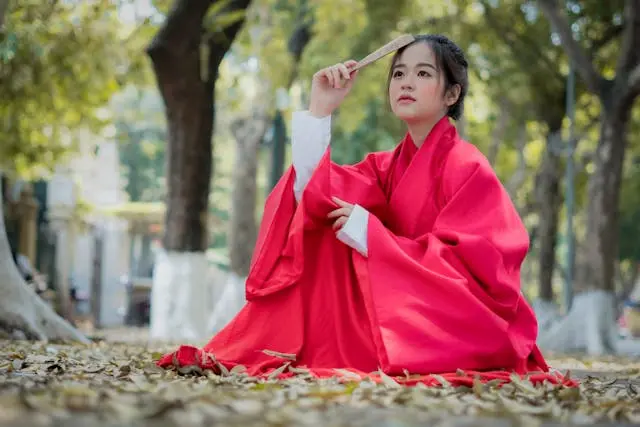
The chima is the skirt. It wraps around and ties at the chest, worn over the jeogori rather than tucked beneath it. This high-waisted silhouette creates the flowing A-line shape that defines the traditional Korean female clothing look. A full chima uses several meters of fabric, which produces the bell-like volume that billows gracefully when a woman moves. If you’ve seen women walking through Gyeongbokgung Palace in Seoul and noticed how the skirts seem to float — that’s the chima doing exactly what it was designed to do.
Beneath these two visible layers, women traditionally wore a set of undergarments: the sokchima (속치마), a plain underskirt that added structure to the outer chima, and the sokjeoksam (속적삼), a thin undergarment worn beneath the jeogori. These pieces were functional rather than decorative, but they shaped how the outer garments sat and moved. You can read more about how the full hanbok system works across different Korean garment categories for broader context.
The Korean Chima: Styles, Colors, and What They Communicated
The korean chima deserves its own section because it varied far more than most guides acknowledge. The basic wrapped skirt came in several distinct silhouettes depending on the occasion, the wearer’s social position, and the region of Korea she came from.
The most formal version was the gyeopchima (겹치마), a lined skirt made of two layers of silk that created a heavier, more structured drape. For everyday wear, women used the hongchima (홍치마) — a plain, single-layer skirt typically in red or crimson, considered the standard working-class skirt color in the Joseon era. Noblewomen (called yangban) wore skirts in deeper, more saturated colors with silk or ramie fabrics, while women of lower social rank were legally restricted in some periods from wearing certain colors and fabric types. The chima’s color was not a matter of personal taste alone; it communicated social rank in a way any observer could instantly read.
Color symbolism in traditional Korean women’s clothing followed the obangsaek system — five cardinal colors drawn from Confucian cosmology: blue (east, wood), red (south, fire), yellow (center, earth), white (west, metal), and black (north, water). Young unmarried women traditionally wore red or pink chima with yellow or green jeogori. Married women often shifted to blue or purple skirts. White was worn during periods of mourning. These weren’t rigid rules enforced in every household, but they were widely understood cultural conventions that shaped what women chose to wear for major life events.
Quick Note: If you’re renting or buying a hanbok for a cultural experience in Korea (at palaces like Gyeongbokgung or Changdeokgung), the rental shops will often dress you in the younger-woman style — bright chima in red, pink, or purple with a contrasting jeogori. This is the most photogenic version and perfectly appropriate for the setting, but it’s worth knowing it reflects one specific tradition within a much wider range of traditional Korean female clothing styles.
How Social Class Shaped Traditional Korean Female Clothing
The most significant gap in most English-language hanbok guides is the failure to explain how dramatically traditional Korean women’s clothing differed based on social class. The royal court hanbok and the commoner hanbok shared the same basic structure but were worlds apart in practice.
According to the National Museum of Korea, court women — including court ladies (naengnyeo) and royal consorts — wore an additional outer robe called the wonsam (원삼) or hwarot (화관) over their jeogori and chima for formal ceremonial occasions. The wonsam was a wide-sleeved, floor-length overcoat with bold stripe detailing on the sleeves (called saekdong, 색동). Royal women wore red wonsam; the queen wore blue or green. These garments required enormous quantities of silk, embroidery, and labor. A single ceremonial wonsam from the Joseon court could weigh several kilograms due to the layering and embellishment.
Commoner women wore the same basic jeogori-chima combination but in ramie (a plant fiber called mosi, 모시) or plain cotton rather than silk. Their jeogori was typically less fitted, their chima less voluminous, and their color palette more muted — not always by choice, but because sumptuary laws (called kimbeop, 禁法) in the Joseon period explicitly restricted the use of certain colors, patterns, and fabrics to specific classes. A merchant-class woman wearing a court-grade silk hanbok could face legal penalties.
This class dimension matters if you’re trying to understand what you’re looking at when you see historical depictions of traditional Korean clothing female figures in paintings, museum exhibits, or K-drama period pieces. The garment tells you immediately who the character is supposed to be — an insight that often gets lost in translation for Western audiences. The cultural layers embedded in hanbok design go even deeper than most people realize when they first encounter the garments.
Fabrics, Embroidery, and the Details That Define Traditional Korean Clothes for Women
Fabric choice is where you feel the real quality difference in traditional Korean clothes for women, and it’s the detail that separates a thoughtfully made hanbok from a cheap replica. Historically, the primary fabrics were silk (called myeongju or sa depending on the weave weight), ramie (mosi), and cotton (mok). Each had its season and social association.
Summer hanboks traditionally used single-ply ramie or lightweight silk gauze — translucent, breathable fabrics that kept women cool in Korea’s humid summers while still maintaining the elegant silhouette. Winter versions layered thicker silks or added padded cotton lining called som (솜) inside the chima and jeogori. If you handle a well-made winter jeogori, the padded lining gives it a quilted warmth that’s surprisingly effective.
Embroidery was reserved primarily for formal and ceremonial garments. The most common motifs included peonies (representing prosperity and femininity), phoenixes (for royal or bridal pieces), cranes (longevity), bats (fortune — a symbol that doesn’t carry Western connotations in Korean tradition), and pomegranates (fertility). These weren’t decorative afterthoughts. Each motif carried a specific meaning, and placing them on a garment was a deliberate act of wishing the wearer well. Bridal hanboks (called hwarot for royal brides or a simpler red ceremonial hanbok for commoners) were often the most densely embroidered garments a Korean woman would ever own.
The norigae (노리개) is the accessory that completes the traditional look and is frequently omitted in simplified guides. It’s a decorative pendant that hangs from the goreum bow of the jeogori — made from silk, jade, coral, amber, or precious metals depending on the owner’s wealth. A court lady’s norigae might include multiple tiers of pendants in carved gemstones. A commoner woman’s might be a single silk knot in a vibrant color. Either way, it’s considered an essential element of the finished traditional Korean women’s clothing look, not an optional extra.
Modern and Fusion Hanbok: Traditional Korean Women’s Clothing Today
The contemporary hanbok scene has split into two clear camps, and knowing which one you’re looking at changes how you evaluate what you’re seeing.
The first is the preservation hanbok — garments made according to traditional construction methods using period-appropriate fabrics, cuts, and embellishments. Organizations like the Korea Craft and Design Foundation actively support artisan hanbok makers who continue these traditions. Their work is worn at major national ceremonies, at rites like chuseok (Korean Thanksgiving) and seollal (Lunar New Year), and at traditional coming-of-age ceremonies. This version of traditional Korean clothing women wear is about continuity — a deliberate connection to historical practice.
The second is the contemporary fusion hanbok, which Korean designers like Leesle and Tchai Kim have been developing since the early 2010s. These garments keep the silhouette — the high-waisted chima, the crossed-collar jeogori — but replace heavy silk with linen, denim, or even technical fabrics. They’re cut for modern proportions and daily wear. You can sit in them on a subway. Some versions have pockets. The goal isn’t to replace the traditional garment but to make the aesthetic vocabulary of traditional Korean female clothing livable outside of ceremonies.
Our take: The fusion hanbok is a genuinely smart development, not a dilution of tradition. The preservation version is irreplaceable for ceremonial contexts, but expecting it to carry the entire weight of keeping hanbok culturally alive is unrealistic. Leesle in particular produces fusion pieces that non-Korean women in the US and UK can wear without the styling feeling like costume — the proportions work with Western body types, the fabrics are practical, and the color palettes are contemporary without abandoning the obangsaek tradition entirely.
One honest trade-off worth stating: fusion hanboks made from modern fabrics won’t move the same way as traditional silk or ramie versions. The dramatic billowing of a full chima in heavyweight silk is partly a function of the fabric’s weight and drape. A linen or cotton fusion chima is lighter and more practical, but you will notice the difference in how it falls. If the visual impact of the silhouette matters to you — for photography, a cultural event, or a wedding — investing in a proper silk chima makes a real difference. For day-to-day wear or a hanbok rental experience, the fusion version is perfectly appropriate. You can also find useful context about how to build a wardrobe around statement pieces if you’re thinking about integrating fusion hanbok elements into everyday dressing.
Frequently Asked Questions
What is the difference between the chima and the jeogori in traditional Korean women’s clothing?
The chima is the full wraparound skirt and the jeogori is the short jacket worn on top. They’re the two core components of the female hanbok. The chima ties at the chest with a drawstring called a heori (허리), sitting at a high waistline that creates the characteristic A-line silhouette. The jeogori fastens at the front with the goreum ribbon bow. Together they form the complete look, though additional layers — underskirts, overrobes, accessories — are added depending on the formality of the occasion.
What do the colors of traditional Korean clothes for women mean?
Colors in traditional Korean female clothing were not purely aesthetic — they communicated age, marital status, and social position. Young unmarried women traditionally wore brighter, warmer colors like red, pink, and yellow-green combinations. Married women often wore more subdued or cooler tones. White was associated with mourning. The five-color obangsaek system — blue, red, yellow, white, and black — underpinned much of the color symbolism, each color tied to a direction, element, and meaning from Confucian cosmology. Court women followed even stricter color conventions tied to their rank within the palace hierarchy.
How is traditional Korean clothing for women different from Japanese kimono?
The two garments are structurally quite different despite superficial similarities. The hanbok is a two-piece system — a separate jacket and skirt — while the kimono is a single wraparound robe belted with an obi. The hanbok silhouette emphasizes a high waistline and a full, flowing skirt with room for natural movement. The kimono emphasizes a straight vertical line with a compressed silhouette and restricted stride. Hanbok fabric tends to be lighter and more colorful in its traditional form; kimono fabric is heavier and often more intricately patterned. The two traditions developed independently and reflect very different aesthetic philosophies.
Can non-Korean women wear traditional Korean clothing?
Yes, and this is actively encouraged at Korean cultural heritage sites. Gyeongbokgung Palace in Seoul runs a well-known hanbok rental program that explicitly welcomes international visitors, and wearing hanbok there grants free entry to the palace grounds. The Korean government and cultural organizations have consistently framed hanbok wearing by non-Koreans as appreciation rather than appropriation, provided the garment is worn respectfully and in the appropriate context. For women in the US or UK looking to wear a fusion hanbok as regular clothing, that’s equally straightforward — the fusion versions are designed for everyday wear without specific ceremonial protocol attached.
What accessories traditionally complete a Korean women’s hanbok?
The norigae pendant is the most significant accessory — a decorative ornament that hangs from the jeogori’s goreum ribbon. Beyond that, traditional footwear called kkotsin (꽃신) — embroidered silk shoes with an upturned toe — complete the lower half. Hair was typically styled up and pinned with ornamental hairpins called binyeo (비녀), often made from jade, gold, or silver depending on status. Married women wore a particular hairpin style that indicated their status. For formal or royal occasions, a gache (가체) — a hairpiece that dramatically extended the volume of styled hair — was worn, though these were eventually banned by royal decree in the late 18th century due to the extreme cost and injury risks associated with their weight.
Where can women in the US and UK buy or rent a traditional Korean hanbok?
In the US, Korean communities in Los Angeles (Koreatown), New York, and the San Francisco Bay Area have rental and retail shops serving the hanbok market, particularly around Lunar New Year. Online, Korean-based retailers like Hanbok Alley and Boryeong ship internationally. In the UK, London’s New Malden district — home to one of Europe’s largest Korean communities — has shops with hanbok rental and purchase options. For fusion hanbok, brands like Leesle and Tchai Kim operate online with international shipping. For a reference point on how Koreans themselves navigate hanbok selection, the men’s guide on this site covers the evaluation process in useful detail that applies to women’s purchasing decisions as well.
Final Thoughts
Korean traditional clothing for women is one of the most layered and deliberately designed clothing traditions in the world. The chima and jeogori aren’t just garments — they’re a system that encoded social position, marital status, seasonal awareness, and aesthetic philosophy simultaneously. Understanding that system changes how you look at every hanbok you encounter, whether in a museum, on a Seoul street, or in a K-drama. The details — the goreum bow angle, the collar color, the skirt volume, the pendant hanging from the tie — all carry meaning when you know what to look for.
If you want to explore further, start with the garment itself: visit a Korean cultural center, book a palace hanbok rental experience if you’re traveling, or look into fusion hanbok pieces from contemporary Korean designers who are doing serious work to make this tradition wearable in daily life. Traditional Korean women’s clothing is worth understanding on its own terms — not just as an aesthetic but as a record of how Korean women have dressed, signaled identity, and expressed beauty across two thousand years.



Leave feedback about this