

hat Is Kimono Traditional Japanese Clothing? 8 Types Explained Simply
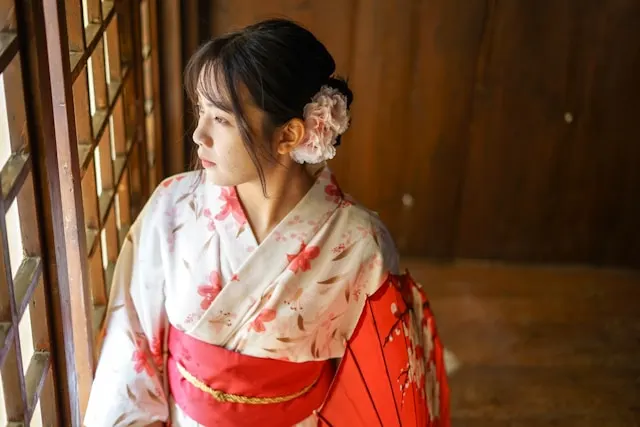
The kimono is Japan’s most iconic traditional garment — a T-shaped, full-length robe worn for centuries across every social class, season, and occasion. Whether you’re exploring Japanese culture, planning a visit, or simply curious about what traditional Japanese clothing is called, this guide covers everything: the types, history, symbolism, and how the kimono evolved into a living art form.
What Is a Kimono?
A kimono (着物) is Japan’s traditional full-body garment. Its silhouette is deceptively simple: two panels of fabric sewn into a T-shape, with wide sleeves and a front that wraps left over right before being secured at the waist by a broad sash called an obi. Yet within that clean outline lies extraordinary complexity — in fabric, pattern, color, and the ritual of wearing it correctly.
The word itself tells you everything. Ki (着) means “to wear,” and mono (物) means “thing.” Literally: a thing you wear. Simple etymology, profound cultural weight.
Today, kimonos are worn at formal events — weddings, tea ceremonies, coming-of-age celebrations — and by anyone who chooses to honor this living tradition. Japan’s kimono artisans are UNESCO-recognized, and the global appreciation for the garment continues to grow.
Names & Terminology
Before diving into types, it helps to understand the vocabulary. Japanese traditional clothing has its own precise language, and getting these terms right makes the rest of the guide much clearer.
The T-shaped full-length robe that is Japan’s most iconic garment.
The broad term for all traditional Japanese-style dress, as opposed to Western-style yōfuku.
The wide, structured sash that ties the kimono shut. It can be as expensive as the kimono itself.
Split-toe socks worn with traditional footwear like zōri sandals or geta wooden clogs.
A casual everyday kimono covered in a repeating all-over pattern.
Circular heraldic crests applied to formal kimonos to indicate social rank or family lineage.
Types & Categories at a Glance
Not all kimonos are equal — the type you wear signals your status, the occasion, and even your age. Here’s a quick reference for the main styles of traditional Japanese clothing kimono, ranked from most to least formal.
| Name | Japanese | Formality | Occasion | Gender |
|---|---|---|---|---|
| Kurotomesode | 黒留袖 | ★★★★★ Highest | Weddings (married women) | Women |
| Furisode | 振袖 | ★★★★★ Highest | Coming-of-age, weddings (unmarried) | Women |
| Montsuki Haori Hakama | 紋付袴 | ★★★★★ Highest | Weddings, formal ceremonies | Men |
| Iromuji | 色無地 | ★★★★ High | Tea ceremony, formal events | Women |
| Houmongi | 訪問着 | ★★★★ High | Parties, formal visits | Women |
| Tsukesage | 付け下げ | ★★★ Semi-formal | Receptions, cultural events | Women |
| Komon | 小紋 | ★★ Casual | Shopping, outings, theatre | Women |
| Yukata | 浴衣 | ★ Most Casual | Summer festivals, hot springs | Both |
The Kimono Up Close: Anatomy of an Icon
To truly appreciate Japan’s traditional dress, you need to understand what makes a kimono a kimono — and why wearing one is almost an art form in itself.
A full kimono ensemble typically includes seven to twelve separate items. The kimono robe itself is cut from a single bolt of fabric called a tan — typically 36 cm wide and 12 meters long. Not a centimeter is wasted; the fabric is cut into eight rectangular pieces and sewn together with almost no shaping curves, which means kimonos are infinitely adjustable and can be completely deconstructed and resewn.
The obi sash is its own world. A formal maru obi can take 15 minutes to tie properly and costs more than many garments. The back knot — obi musubi — comes in dozens of forms, from the classic taiko (drum shape) to elaborate butterfly and flower knots for young women.
— Traditional saying among Japanese kimono artisans
Kimono for Women: The Major Types
Women’s kimonos are far more varied than men’s. Formality, sleeve length, and pattern placement all carry meaning — and a well-dressed woman in kimono communicates volumes before she says a word.
Furisode — The Unmarried Woman’s Formal Kimono
The furisode (振袖) is unmistakable: its swinging sleeves can reach 100–114 cm in length. Bright, bold, and covered in elaborate hand-painted or embroidered patterns, furisode are worn by young unmarried women at coming-of-age ceremonies (seijin-shiki), weddings, and New Year celebrations. After marriage, women traditionally stop wearing furisode and adopt the shorter-sleeved tomesode.
Kurotomesode — The Married Woman’s Highest Honor
Solid black with patterns only below the waistline, the kurotomesode (黒留袖) is the most formal kimono a married woman can wear. It always features five family crests (itsutsu-mon) and is reserved almost exclusively for weddings — typically worn by the mothers of the bride and groom.
Houmongi — The Visiting Kimono
Literally “visiting wear,” the houmongi (訪問着) is a semi-formal kimono distinguished by its continuous pattern that flows across seams as if the entire garment is one painted canvas. Houmongi are worn to parties, exhibitions, formal receptions, and cultural events by both married and unmarried women.
Iromuji — Quiet Elegance for the Tea Room
The iromuji (色無地) is a single-color kimono with no pattern — just a rich, solid hue. Its understated quality makes it perfect for tea ceremony, where busy patterns would distract from the meditative atmosphere.
Yukata — Summer’s Casual Icon
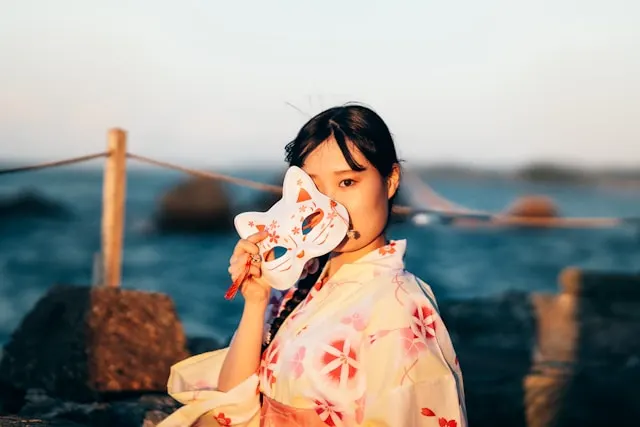
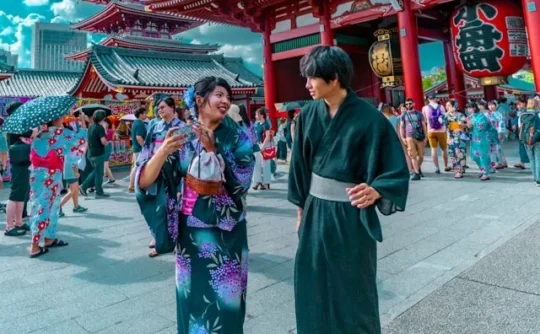
The yukata (浴衣) is the cotton informal kimono most visitors to Japan encounter first — worn at summer festivals, fireworks displays, and ryokan inns. Lighter than a full kimono, it’s worn directly against the skin without an underlining.
Kimono for Men: Restrained Power
Men’s traditional Japanese clothing tends toward darker, more subdued tones — navy, charcoal, brown, black — with the status signaled by fabric quality and the number of family crests rather than bold color.
Montsuki Haori Hakama — The Full Formal Ensemble
For a man, the equivalent of a morning suit is the montsuki haori hakama (紋付羽織袴): a black silk kimono bearing five family crests, covered by a hip-length haori jacket and finished with wide-legged hakama trousers.
Haori — The Kimono Jacket
The haori (羽織) is a hip- or thigh-length jacket worn open over a kimono. Originally a military garment, it became a symbol of masculine style during the Edo period.
Hakama — The Pleated Trousers
Wide, divided trousers worn over the kimono, hakama (袴) are associated with samurai, martial arts (kendo, aikido), and formal ceremony.
Men’s Yukata
Men’s yukata are simpler and more geometric than women’s — dark blue with white patterns, or subtle stripes. They’re worn at summer events and are considerably easier to put on than a formal kimono.
History of the Kimono: A Timeline
The kimono didn’t appear fully formed — it evolved over fifteen centuries of cultural exchange, political change, and artistic innovation.
Chinese influence arrives. Japanese clothing borrows heavily from Tang Dynasty China — layered robes, wrapped fronts, and the basic T-shape that still defines the kimono today.
Layers become art. Aristocratic women wore the jūnihitoe — twelve layered robes in carefully coordinated color gradients. This remains the most elaborate clothing tradition in Japanese history.
Practicality takes over. As samurai culture rose, clothing simplified. The kosode — a short-sleeved under-robe — moved to the outermost layer and became the direct ancestor of today’s kimono.
The golden age of kimono craft. Dyeing techniques like yuzen (hand-painting) and shibori (resist dyeing) flourished. Sumptuary laws tried — largely unsuccessfully — to stop merchants from outshining the samurai class.
Western dress arrives. Japan rapidly modernized. The word kimono gained its current specific meaning as traditional dress was distinguished from Western-style yōfuku.
Cultural treasure and global fashion. Post-war industrialization pushed kimono to ceremonial occasions. Today, a revival movement among younger Japanese is reintroducing kimono to daily life in both traditional and reimagined forms.
Culture & Symbolism: What Your Kimono Says About You
Every element of a kimono is chosen deliberately. Color, pattern, fabric, and season all communicate meaning.
Color symbolism is equally precise. White represents purity and is worn at weddings and funerals alike. Red is vitality and good fortune. Black signals formality and mourning depending on context. Purple historically denoted imperial rank.
Patterns carry their own vocabulary. Cranes (tsuru) symbolize longevity and marital happiness. Carp (koi) represent perseverance. Waves (seigaiha) suggest the ocean’s infinite power. Chrysanthemums (kiku) are the imperial flower.
Family crests (mon) transform a kimono into an identity document. A five-crest formal kimono announces your family lineage to every observer.
Frequently Asked Questions
The general term is wafuku (和服), meaning “Japanese-style clothing.” The most famous type is the kimono (着物). Other wafuku garments include the yukata, hakama, haori, and the historical jūnihitoe.
A yukata is a casual, unlined cotton kimono worn in summer. A full kimono is typically silk, requires an inner lining, and can be worn in all seasons. Kimonos are more formal, more expensive, and more complex to put on.
Yes — in Japan, tourists and foreigners wearing kimono are generally welcomed and encouraged. Many Japanese people see it as genuine appreciation for their culture. Wear it respectfully: left over right, appropriate type for the occasion.
Ancient Japanese clothing consisted of separate upper and lower garments. From around the 8th century, Chinese Tang Dynasty influence introduced the layered robe system. By the Heian period, aristocrats wore the elaborate jūnihitoe. The modern kimono descended from the simpler kosode of the feudal era.
A casual yukata costs ¥3,000–¥15,000 (~$20–$100). An everyday komon runs ¥30,000–¥100,000. A formal silk furisode with hand-painted yuzen can cost ¥300,000–¥1,000,000+ (~$2,000–$7,000+). Full formal ensembles can exceed $10,000. Beautiful vintage pieces are available for much less.
A bride wears a shiromuku — a pure white kimono — or an iro-uchikake, a heavily embroidered outer robe in vibrant red or gold. The groom’s mother wears a kurotomesode, while unmarried younger women wear furisode.
Korean traditional clothing is the hanbok (한복). Unlike the kimono’s T-shape, the hanbok features a short jacket (jeogori) with a billowing high-waisted skirt (chima) for women. Both share East Asian roots but their cuts, silhouettes, and cultural contexts are very different.
The kimono is far more than a Japanese dress name — it’s a living document of a civilization’s aesthetic values, social codes, and artistic mastery. From the billowing sleeves of a furisode to the quiet dignity of an iromuji at a tea ceremony, every type of traditional Japanese clothing carries centuries of meaning in its folds.
Whether you wear one, study one, or simply appreciate one behind glass, the kimono rewards attention. There’s always another layer of meaning to discover — which, perhaps, is the whole point.

Leave feedback about this