

Traditional Chinese Clothing for Men Explained: History, Styles & Modern Wear
According to the Victoria and Albert Museum in London, the Chinese long robe — known as the changshan — reached its most refined form during the Qing dynasty (1644–1912), when court dress became one of the most codified clothing systems in world history. Color, embroidery pattern, and garment cut were regulated by imperial law, with severe penalties for anyone who dressed above their station. That level of sartorial seriousness tells you something about how deeply traditional Chinese men’s clothing was woven into questions of identity, rank, and cultural belonging.
This article covers the key garments that make up traditional Chinese clothing for men — the changshan, the tangzhuang jacket, the zhongshan suit, and the ancient hanfu — along with how each one developed, what it means culturally, and where men in the US and UK are actually wearing these pieces today. You’ll also find guidance on fabric, fit, and where to source authentic or well-made modern versions.
Most guides on this topic either stay too shallow (brief definitions, no context) or treat the subject as pure history with no practical application. This article does something different: it treats traditional Chinese men’s clothing as a living subject, covering both its deep historical roots and its genuine relevance for modern occasions — from Lunar New Year celebrations to cultural weddings to contemporary fashion choices.
The Core Garments in Traditional Chinese Men’s Clothing
Traditional Chinese clothing for men is not a single style — it’s a family of distinct garments that evolved across different dynasties, regions, and social classes. Understanding what each one is, and where it comes from, is the starting point for wearing any of them with confidence.
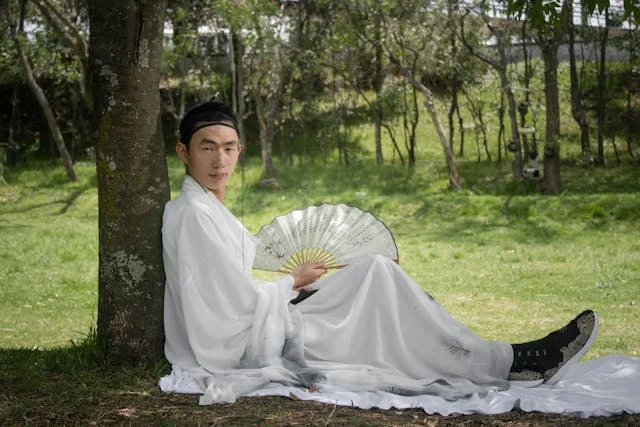
The hanfu is the oldest category. It refers to the traditional dress of the Han Chinese people, covering a broad range of robes, tunics, and layered garments worn from roughly 200 BCE through the Ming dynasty. For men, hanfu typically consisted of a cross-collar robe (ruqun or shenyi) with wide sleeves, a sash belt, and layers that varied by season and occasion. The silhouette is flowing and formal — nothing like modern Western business wear, but deeply intentional in its structure.
The changshan (also called cheongsam for men in Cantonese) is a long robe that became standard for Chinese men during the Qing dynasty and remained popular into the early 20th century. It features a Mandarin collar, front buttons or toggles running diagonally, and a fitted body — far more tailored than earlier hanfu. This is the garment most Western audiences associate with formal Chinese men’s traditional wear, and it’s still worn at weddings, tea ceremonies, and Lunar New Year events today.
The tangzhuang is a shorter, jacket-style garment that pairs with trousers. It evolved from Qing-era riding jackets and became widely recognized internationally after being worn by world leaders at the 2001 APEC summit in Shanghai. It sits closer to a blazer in function — easy to wear with contemporary trousers, approachable for men who want a cultural reference without committing to a full robe.
The zhongshan suit, known in the West as the Mao suit, was designed in the early Republic era (around 1912) as a deliberate blend of Chinese and Western tailoring. Four pockets, a turn-down collar, and a buttoned front — it looks structured and formal but reads differently from either a Western suit or older Chinese robes. It’s worth understanding as part of men traditional Chinese clothes history, even if it’s the most politically freighted of the group.
How Dynasty and Social Rank Shaped Men’s Traditional Chinese Apparel
The relationship between Chinese traditional wear and social hierarchy is one of the most underreported aspects of this topic. It wasn’t just fashion — it was a legal and political system expressed through cloth.
According to the Palace Museum in Beijing, the Qing dynasty imperial dress code specified exactly which dragon embroidery patterns were permitted at which rank. Emperors wore five-clawed dragons (long) on yellow silk; princes used four-clawed dragons (mang) on specific restricted colors; officials at lower ranks wore roundels featuring cranes, pheasants, or other creatures according to their bureaucratic grade. Wearing the wrong emblem was a criminal offense, not a style choice.
During the Han dynasty, color itself carried legal weight. The emperor’s exclusive claim to certain yellow tones meant that commoners dressed almost entirely in undyed hemp or pale silk. Only by the Tang dynasty (618–907 CE) did a wider range of colors become accessible to wealthy non-imperial men, including the blues, greens, and reds now associated with traditional Chinese festive dress. You can read more about how these dynastic codes evolved in our article on ancient Chinese clothing across dynasties and their symbolic meaning.
Accessories also carried rank. The official court hat — the liangmao — came in different forms for different grades of officials. Belt buckles, jade pendants, and shoe styles all communicated social position in a visual language that any educated observer could read immediately. This means that when you look at historical Chinese men’s dress, you’re reading a coded document, not just a garment.
The Hanfu Revival and What It Means for Men Today
One of the most significant — and underreported — developments in men’s traditional Chinese clothing is the hanfu movement, which has grown from an internet subculture in China into a mainstream fashion phenomenon over the past decade.
According to a 2023 report by iiMedia Research, the hanfu market in China was valued at over 14.4 billion yuan (approximately $2 billion USD), with an estimated 7.3 million regular hanfu wearers nationally. That’s not a niche hobby. Men’s hanfu — particularly the more structured shenyi robe and shorter ruqun combinations — account for a meaningful share of that market, worn at cultural festivals, photography sessions, tea ceremonies, and increasingly on the street as everyday fashion.
For men in the US and UK interested in this category, two things are worth knowing. First, contemporary hanfu for men has branched into a wide range — from historically accurate reconstructions based on Tang and Song dynasty sources, to modern interpretations that use traditional silhouettes with updated fabrics and simplified construction. Second, not all pieces read the same in a Western context. A full shenyi (cross-collar robe) will read as costume to most Western observers; a structured tangzhuang jacket over dark trousers reads as intentional contemporary fashion.
For a deeper foundation on the garment types and their historical origins, the guide to Chinese traditional clothing names, types, and history covers the naming conventions and garment categories in detail.
Quick Note: The terms “cheongsam” and “qipao” are most commonly used for women’s garments in Western contexts. For men’s traditional robes, “changshan” is the more accurate term — though “male cheongsam” is widely used and understood in English-speaking communities.
Fabric, Fit, and Sourcing: What to Actually Look For
Knowing the garments is one thing. Knowing how to choose and source a well-made piece is where most guides stop being useful. Here’s what actually matters when buying men’s traditional Chinese clothes outside of China.
Fabric is the first consideration. Authentic historical garments were almost always silk — specifically various weights of raw silk, brocade, or embroidered damask for formal wear, and linen or cotton for everyday use. Contemporary pieces use everything from polyester (cheap, shiny, and worth avoiding for anything except costume use) to genuine silk brocade (expensive, correct, and worth it for a changshan or formal tangzhuang). For men buying a tangzhuang for Lunar New Year or a family event, a silk-cotton blend from a reputable maker will wear well and photograph beautifully without the price tag of pure silk.
Fit matters more than most people expect. A changshan that fits correctly sits close to the body through the chest and shoulders, with the collar lying flat against the neck and the front toggle closure lying smooth — no pulling or gaping. If the collar buckles away from your throat or the buttons create diagonal stress lines across the chest, it’s the wrong size. Most Chinese traditional garment makers size narrower through the shoulder than Western brands, so measuring carefully and comparing against the size chart (not assuming your usual shirt size) is essential.
On sourcing: in the US, brands like Wah Yan (based in New York’s Chinatown) have decades of experience in traditional Chinese tailoring. In the UK, Chinatown-area tailors in London’s Gerrard Street neighborhood have long served the British-Chinese community with both ready-to-wear and bespoke traditional pieces. Online, Shanghai Tang — the luxury brand founded in Hong Kong in 1994 — offers contemporary interpretations of changshan and tangzhuang that sit at the higher end of quality and price.
Our take: For men buying their first traditional Chinese garment, the tangzhuang jacket is the right starting point. It’s versatile, it pairs with contemporary trousers, and a well-made version from a reputable tailor will last decades. Skip the cheap polyester sets sold for costume use — the construction fails after a few wears and the fabric photographs poorly. A $120–$200 silk-blend tangzhuang from a proper Chinese tailoring house is a significantly better investment than a $40 fast-fashion version.
Wearing Traditional Chinese Men’s Clothing in the US and UK Today
The question of when and how to wear men’s traditional Chinese clothing outside of China is one that matters to a lot of men — particularly those navigating cultural identity in predominantly Western contexts. There’s no single right answer, but there are useful frameworks.
The clearest occasions are cultural events: Lunar New Year dinners, Chinese Mid-Autumn Festival gatherings, family weddings where the groom or male relatives want to honor Chinese heritage, and community festivals. A changshan or tangzhuang at these events is received warmly and reads as culturally intentional — exactly what it should be.
For non-Chinese men attending these events as guests, a tangzhuang is a respectful choice if it’s genuinely well-made and worn thoughtfully. The key distinction is between wearing a garment in appreciation of a culture versus wearing a costume version of it. Quality matters here — not just aesthetically, but as a signal of seriousness.
The growing interest in traditional Chinese apparel among younger Chinese-American and British-Chinese men also intersects with broader conversations about heritage fashion. Designers like Feng Chen Wang (born in Fujian, based between London and Shanghai) have incorporated tangzhuang and changshan references into contemporary menswear collections shown at London and New York Fashion Weeks — moving these garments firmly into mainstream fashion territory without stripping them of their cultural significance.
One honest trade-off worth noting: a full changshan or hanfu robe is a formal, structured garment. It is not comfortable for an entire day of movement-heavy activity, and the collar can feel constricting during a long event. Men who want the cultural reference without the physical constraints often choose a tangzhuang jacket as their outer layer, which gives the visual register of traditional Chinese men’s clothing while allowing considerably more freedom of movement.
Frequently Asked Questions
What is the difference between hanfu and a changshan for men?
Hanfu refers broadly to the traditional clothing of Han Chinese people across more than 2,000 years of history — it covers many garment types including robes, tunics, and layered ensembles. A changshan is a specific garment: a long fitted robe with a Mandarin collar and diagonal button closure that developed during the Qing dynasty. Think of hanfu as the category and changshan as one of its later, more tailored expressions. They’re related but distinct, and wearing one doesn’t mean you’re wearing the other.
Is it appropriate for non-Chinese men to wear traditional Chinese clothing?
This question comes up often, and the answer depends significantly on context and how the garment is worn. Wearing a well-made tangzhuang or changshan to a Chinese cultural event as a genuine mark of respect is generally received positively by Chinese and Chinese-diaspora communities. Wearing a poorly made costume version for Halloween or as a joke is a different matter entirely. The distinction between appreciation and reduction comes down to quality, context, and intention — and that holds true whether you’re Chinese or not.
What should men wear to a Chinese wedding as a guest?
Traditional Chinese weddings typically welcome guests in formal attire — Western suits are perfectly appropriate and common. If you want to wear something culturally specific, a tangzhuang jacket in a festive color (red, gold, or deep blue are all appropriate; avoid white and black, which carry funeral associations in Chinese tradition) worn over dark trousers is a strong choice. A changshan robe is also appropriate if you’re comfortable with the formality. Check with the couple if you’re unsure — most will be honored that you asked.
How do I care for a silk or silk-blend changshan?
Silk garments need cool water or dry cleaning — hot water and machine washing will shrink the fabric and damage the weave. For light cleaning, hand washing in cool water with a gentle detergent is usually safe, but check the care label first since brocades and embroidered pieces are often dry-clean only. Always store a changshan on a padded hanger rather than folded, as fold lines in silk brocade can become permanent creases. Press with a low iron on the reverse side, never directly on embroidery.
Where can men in the US buy authentic traditional Chinese clothing?
For ready-to-wear pieces, established Chinatown districts in cities like New York, Los Angeles, and San Francisco have tailoring shops with decades of experience in traditional Chinese garments — these are preferable to online fast-fashion sellers. Online, Shanghai Tang ships internationally and offers genuinely well-constructed contemporary pieces in traditional silhouettes. For historically accurate hanfu, specialist online retailers based in China (such as Han Tang Hui or HAODUOYI) ship to the US and UK and produce garments with documented historical references rather than generic approximations.
What colors are traditional in men’s Chinese formal wear?
Historically, color in Chinese men’s formal wear was heavily regulated by rank. Red has long been associated with good fortune and celebration — it remains the most common choice for festive occasions including weddings and New Year events. Deep blue, forest green, and black were standard for formal scholar and official dress. Gold embroidery on dark backgrounds remains a classic combination for formal traditional Chinese wear. In contemporary contexts, navy, burgundy, and charcoal are all used in tangzhuang designs and work well for men who want something formal but slightly more restrained than red.
Final Thoughts
Traditional Chinese clothing for men covers a rich and specific body of garments — each with its own history, construction logic, and cultural weight. The changshan, tangzhuang, hanfu robes, and zhongshan suit are not interchangeable terms for “Chinese clothes.” They’re distinct garments with different occasions, silhouettes, and meanings. Knowing the difference makes you a more informed wearer and a more thoughtful guest at any event where these garments appear.
If you’re ready to add a piece to your wardrobe, start with a well-made tangzhuang jacket from a reputable tailor or established retailer — it’s the most practical entry point and the easiest to wear across different occasions. Avoid polyester and anything marketed primarily as a costume. For the full historical picture behind what you’d be wearing, the history of ancient Chinese clothing across dynasties is a solid next read.



Leave feedback about this