

Ancient Chinese Clothing: Dynasties, Styles & Meaning
According to the Smithsonian Institution, Chinese textile production dates back at least 5,000 years, with silk weaving already a sophisticated craft during the Neolithic period. That remarkable history means ancient Chinese clothing is not a single style but an evolving visual language that shifted with every ruling dynasty, from the austere robes of the Zhou period to the richly embroidered court costumes of the Ming. Few fashion traditions in human history have matched its combination of symbolic depth and technical mastery.
This article covers the major garment types, the dynasties that defined them, the role of color and embroidery as status codes, and what distinguishes Qing dynasty clothing from everything that came before it. It also looks at how these ancient traditions are shaping contemporary Chinese fashion on runways and streets today. Whether you are a fashion historian, a costume designer, or simply someone curious about one of the world’s oldest dress cultures, what follows gives you specifics rather than vague generalities.
Most articles on this topic give you a quick overview of the hanfu and call it done. This one goes further — covering the underappreciated role of rank badges, explaining why the Qing dynasty represented a genuine rupture in Chinese dress rather than just evolution, and addressing the modern Hanfu Revival movement with honest commentary on what it gets right and where it oversimplifies. You will leave with a clearer picture than any single-dynasty survey can offer.
How Ancient Chinese Clothing Reflected Social Order
The relationship between dress and hierarchy in ancient China was precise to a degree that is difficult to fully appreciate today. Emperors, scholars, military officials, merchants, and farmers each wore specific garments that signaled their position within the social order at a glance. The system was not informal. The Zhou dynasty (1046–256 BCE) codified dress regulations in ritual texts, most famously the Rites of Zhou, which assigned particular robes, colors, and ceremonial objects to each level of the aristocracy.
The most fundamental ancient garment was the hanfu, a broad term covering a family of wrap-style robes characterized by crossed collars, wide sleeves, and a right-over-left lapel closure — the left-over-right style was reserved for the dead, a distinction that shows how deeply meaning was embedded in every construction detail. Beneath formal robes, both men and women wore an inner garment called the zhongyi, followed by a ru (upper jacket) and a shang (lower skirt or trousers). These layers were not simply about warmth. Each transition between layers represented a visual and social boundary.
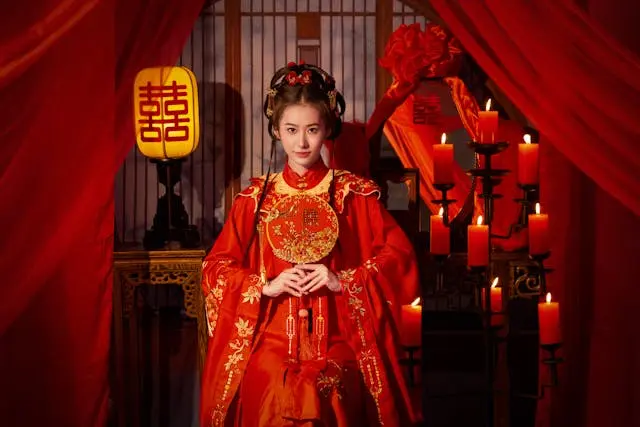
Color was one of the clearest markers of status. Yellow became the exclusive color of the emperor during the Tang dynasty and remained so through subsequent dynasties. Red signified celebration and high rank. Black and white carried ritual associations with mourning. Scholars and lower officials typically wore blue or green robes, while commoners were restricted to undyed or earth-toned hemp fabrics. Wearing a color above your station was a punishable offense — a fact that underlines how seriously the system was enforced rather than merely observed.
For anyone interested in how other Asian cultures managed the same interplay of dress and hierarchy, the comparison with Japanese royal clothing traditions is genuinely illuminating — both systems used layering and color as status signals, though the specific codes diverged considerably.
Key Garments Across the Major Dynasties
The Shang dynasty (circa 1600–1046 BCE) gives us the earliest documented evidence of Chinese clothing through bronze vessels and oracle bone inscriptions. Garments of this era were straight-cut, with minimal tailoring, and silk was already being produced for the elite. The Zhou period that followed institutionalized these garments into formal ceremonial dress, creating the first unified dress code in Chinese history.
The Han dynasty (206 BCE–220 CE) represents a high point for the traditional shenyi — a single-piece robe that wrapped around the body and could be worn by both sexes. Han-era tombs, particularly the remarkable Mawangdui site in Hunan province, have yielded extraordinarily well-preserved silk garments that give modern researchers an accurate look at construction techniques. The silk gauze burial suit found at Mawangdui weighs just 49 grams, a testament to the sophistication of Han textile production.
The Tang dynasty (618–907 CE) is often considered the most cosmopolitan period in ancient Chinese fashion. Trade along the Silk Road brought Central Asian and Persian influences directly into the imperial court. Women’s fashion became notably bolder — high-waisted skirts, open necklines, and hairstyles influenced by foreign cultures all appear in Tang paintings and figurines. Tang women of the aristocracy sometimes wore men’s riding garments, a practice that the court periodically attempted to restrict. This period also saw the widespread adoption of the pifeng, a cape-like outer robe that became a symbol of elite status.
The Song dynasty (960–1279 CE) pulled back toward greater restraint. Neoconfucian philosophy valued modesty and practicality over display, and this showed in dress. Song robes were more narrowly cut than their Tang predecessors, colors were muted, and ornamentation was toned down. The period produced significant innovations in textile technology, including advances in silk damask weaving that allowed for more complex self-patterned fabrics without additional embroidery.
If you want a useful parallel for understanding how garment construction encoded cultural meaning in East Asia more broadly, the analysis of ancient Japanese clothing and social rank covers comparable territory from a different cultural angle.
Qing Dynasty Clothing: A Deliberate Break from Tradition
The Qing dynasty (1644–1912 CE) deserves separate treatment because it represents something genuinely different from the dynasties that preceded it. When the Manchu-led Qing forces overthrew the Ming dynasty, they did not simply take power — they imposed their own dress on a Han Chinese population that had worn hanfu for millennia. The Queue Order of 1645 forced Han men to adopt the Manchu hairstyle and dress under penalty of death. This was not cultural evolution; it was deliberate replacement.
The signature garment of Qing dynasty clothing was the changpao (also called the dragon robe for court versions), a long, tube-cut robe with a horseshoe-shaped cuff that reflected Manchu equestrian origins. For women, the qipao — later known in the West as the cheongsam — developed during this period as a Manchu women’s garment before being transformed in the early 20th century into the figure-hugging silhouette most people recognize today. The Qing court also developed an elaborate system of rank badges called buzi, square embroidered patches worn on the chest and back of official robes that depicted specific animals for civil officials (cranes for the first rank, golden pheasants for the second, and so on) and animals for military officials.
According to the Metropolitan Museum of Art, Qing imperial robes required up to two years of skilled labor to complete, with a single dragon robe containing over a hundred thousand individual stitches. The symbolism was exhaustive: the five-clawed dragon was exclusive to the emperor and highest princes, four-clawed dragons appeared on robes of lower ranks, and the arrangement of waves, clouds, and mountains on the robe’s lower half carried cosmological meaning representing the universe itself.
Our take: The Qing dynasty gets underrepresented in Western coverage of traditional Chinese fashion because discussions tend to jump straight from the Tang dynasty to the modern qipao. That is a mistake. Qing court dress represents one of the most technically demanding and symbolically rich clothing systems ever developed, and understanding it changes how you read the entire history. If you study only one dynasty in depth, make it the Qing — the visual vocabulary it created still echoes in contemporary Chinese ceremonial dress.
Embroidery, Silk, and the Craft Behind Ancient Traditional Chinese Clothing
The technical foundations of ancient traditional Chinese clothing are inseparable from two materials above all others: silk and embroidery thread. Silk production — sericulture — was a Chinese monopoly for roughly three thousand years, and the Chinese government executed anyone who attempted to smuggle silkworm eggs or mulberry seeds out of the country. This monopoly gave China extraordinary leverage along the Silk Road trade networks and meant that the finest garments worn anywhere from Rome to Persia were made from Chinese-produced fabric.
Chinese embroidery developed several distinct regional schools, each with characteristic techniques. Suzhou embroidery, from Jiangsu province, is famous for its double-sided work — designs that look identical on both sides of the fabric, a technical feat that remains extraordinarily difficult. Hunan embroidery favors bold, realistic depictions of animals and landscapes using long and short stitches that create subtle gradations of color. Guangdong embroidery (Cantonese embroidery) uses gold and silver thread more extensively than other schools and has a denser, more opulent visual quality.
Beyond embroidery, ancient Chinese textile workers developed kesi — a tapestry weave technique that could reproduce paintings in silk with remarkable fidelity. Kesi panels were so valued that they were sometimes cut from existing artworks and remounted, treated as luxury objects in their own right rather than simply as decoration on garments. The Palace Museum in Beijing holds thousands of examples that illustrate the range of what was technically possible.
Quick Note: When sourcing replica or reproduction hanfu garments today, the stitching density and fabric weight are the clearest indicators of quality. Mass-produced fast-fashion versions use synthetic fabrics and machine embroidery that look similar in photographs but feel and drape completely differently from authentic reproductions. Brands like Shisanyu (China) and Heaven Official’s Blessing-inspired collections from smaller artisan studios offer significantly higher fidelity for serious enthusiasts.
The Modern Hanfu Revival and China Traditional Fashion Today
Since approximately 2003, a grassroots movement called the Hanfu Movement has been advocating for the revival of traditional Han Chinese dress as a form of cultural identity. According to a 2021 report by the China Hanfu Association, more than 6 million people in China regularly wear hanfu garments, a number that has grown substantially in the years since. The movement has generated significant commercial activity — dedicated hanfu shops operate in nearly every major Chinese city, and social media platforms like Douyin (Chinese TikTok) host millions of videos showing hanfu styling, historical accuracy debates, and modern adaptations.
The revival is not without genuine complications. Scholars and practitioners disagree sharply about what “authentic” hanfu actually means — whether it should prioritize Tang, Song, Ming, or earlier dynasty styles, and how much modern adaptation is acceptable. Some communities within the movement are strict historical reconstructionists; others treat hanfu as a starting point for creative fashion rather than a museum artifact. This tension between preservation and adaptation is productive in some ways and contentious in others.
On the international runway, designers like Guo Pei (whose work Lady Gaga wore to the 2019 Met Gala) and Uma Wang have drawn heavily on the visual language of ancient Chinese fashion, though both work in contemporary high fashion rather than strict historical reproduction. In the UK, brands like Yifang Wan have brought Qing-influenced aesthetics to London Fashion Week, demonstrating that china traditional fashion continues to find new audiences far beyond its country of origin.
This parallel interest in dressing from historical traditions is not unique to China. If you are interested in how comparable revivals work in other Asian contexts, the coverage of traditional Japanese clothing types gives useful comparison points for how historical garments get reinterpreted for modern audiences.
One honest trade-off worth acknowledging: the Hanfu Revival’s emphasis on Han Chinese dress has occasionally been criticized for inadvertently sidelining the dress traditions of China’s 55 other officially recognized ethnic minorities, each of which has its own distinct textile and costume heritage. The Miao, Yi, Dong, and Zhuang communities, for example, maintain embroidery and textile traditions that are just as historically significant as hanfu. An interest in ancient Chinese clothing is genuinely incomplete if it stops at the majority Han tradition.
For a broader look at how traditional dress functions as cultural identity across different contexts, the article on what traditional Chinese outfits mean beyond their visual appearance covers the cultural and symbolic dimensions in useful depth.
Frequently Asked Questions
What is the difference between hanfu and the qipao?
Hanfu is a broad category describing traditional Han Chinese dress that developed over thousands of years before the Qing dynasty. It is characterized by crossed collars, wide sleeves, and wrap-style construction. The qipao (also called cheongsam) is a Qing dynasty-origin garment — initially a straight-cut Manchu robe — that was dramatically reinterpreted in 1920s Shanghai into the fitted, side-slit silhouette most people recognize. They come from different ethnic and dynastic traditions, and conflating them is one of the most common errors in popular writing about Chinese fashion history.
What colors were ordinary people allowed to wear in ancient China?
Commoners in most dynasties were restricted to undyed, naturally pigmented, or earth-toned fabrics — browns, grays, and off-whites from hemp, ramie, or low-grade silk. Bright colors, especially yellow and certain reds, were reserved for the imperial family and high officials. Wearing restricted colors was treated as a form of impersonation of one’s betters and was punishable. The precise restrictions varied by dynasty, but the basic principle — that color communicated rank — remained constant across Chinese imperial history for over two thousand years.
How is Qing dynasty clothing different from earlier Chinese dynasties?
The core difference is ethnic and political origin. Qing dress was imposed by the Manchu ruling class on a predominantly Han Chinese population that had worn hanfu for millennia. Qing garments, including the changpao and the distinctive horseshoe cuff, reflect Manchu equestrian culture rather than Han textile traditions. Earlier dynasties — Han, Tang, Song, Ming — all worked within or developed from the same basic hanfu framework. The Qing represents a genuine discontinuity, not just stylistic evolution, which is why the modern Hanfu Revival explicitly positions itself as reclaiming pre-Qing traditions.
What fabrics were used in ancient Chinese clothing?
Silk was the prestige material for the aristocracy and imperial court from at least the Shang dynasty onward. Common people wore hemp, ramie, and later cotton (which became widespread only from the Song dynasty). High-status garments often combined silk base fabrics with elaborate embroidery, kesi tapestry weave, or metallic thread work. Regional variation was significant — southern China produced finer, lighter silks, while northern court dress tended toward heavier, more structured fabrics suited to colder climates.
Is hanfu still worn in China today?
Yes, and increasingly so. The Hanfu Revival movement, which began in the early 2000s, has grown into a significant cultural and commercial phenomenon. The China Hanfu Association reported more than 6 million regular wearers in 2021, with younger generations driving most of the growth. Hanfu is now worn at cultural festivals, university graduations, photo shoots, and increasingly as everyday fashion in major cities. Online communities debate historical accuracy intensely, and the market supports everything from mass-produced affordable versions to painstakingly hand-sewn museum-quality reproductions costing thousands of dollars.
What should I look for when buying a hanfu garment for the first time?
Start by deciding which dynasty’s style interests you most — Tang, Song, and Ming all have distinct silhouettes. For a first purchase, a Song-style ruqun (a matched top and skirt) is forgiving to wear and relatively easy to style. Prioritize natural fabrics like cotton or ramie over polyester, which drapes poorly and looks unconvincing. For a specific recommendation: Shanghai-based studio Hanfu Story and Beijing-based brand Twelve Hours (Shisanyu) both offer well-documented dynasty references, accurate construction, and natural fabric options at mid-range price points accessible to buyers in the US and UK through international shipping.
Final Thoughts
Ancient Chinese clothing is one of the most layered and precisely coded dress traditions in human history. From the wrap-style hanfu robes of the Zhou dynasty to the symbolically dense dragon robes of the Qing imperial court, every garment carried meaning that went far beyond protection from the elements. Understanding these distinctions — between dynasties, between ethnic traditions, between court and commoner dress — gives you a far richer appreciation of what you are looking at when you encounter Chinese historical costume in museums, films, or contemporary fashion.
The single most useful next step, if this topic genuinely interests you, is to look at primary source materials rather than relying entirely on secondary summaries. The Palace Museum (故宫博物院) in Beijing maintains an extensive online collection of Qing dynasty robes with high-resolution photography and detailed catalog notes, accessible in English at their official website. Spending an hour there will show you details of rank badge embroidery and dragon robe construction that no article can fully convey.



Leave feedback about this