

Traditional Japanese Clothing for Men: History, Types & Modern Tips
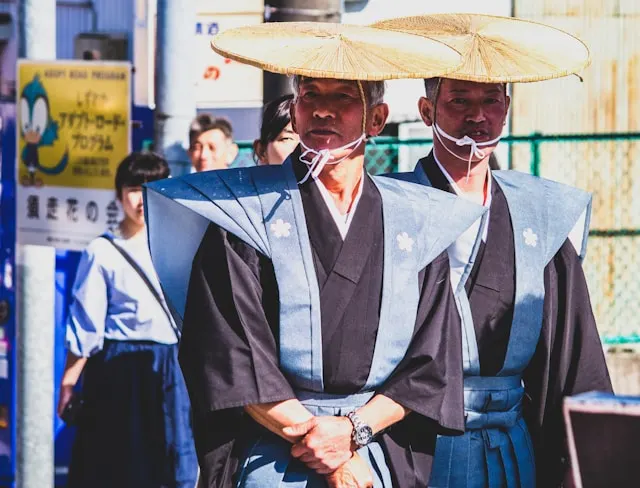
Traditional Japanese clothing for men is one of the world’s most sophisticated dress traditions — shaped by centuries of court culture, warrior codes, and Zen aesthetics. Whether you’re drawn to the structured elegance of a formal kimono, the rugged utility of samurai garments, or the everyday ease of a yukata, this guide walks you through every major garment, its history, and how it’s worn today. For a broader overview that covers both men’s and women’s garments together, see our complete guide to traditional Japanese clothing.
What Is Traditional Japanese Clothing?
The umbrella term for Japan’s classical dress is wafuku (和服) — literally “Japanese clothing.” It encompasses every garment worn before Western fashion arrived in the Meiji era (1868). Wafuku is defined by its T-shaped silhouette, straight-cut fabric panels, and a wrapping style that closes left over right (right over left is reserved for the deceased). It stands in contrast to yōfuku (洋服), or Western-style clothing, which dominates modern Japanese streets.
What makes wafuku remarkable isn’t just visual beauty — it’s that the same foundational construction has persisted for over 1,000 years. Fabric patterns, accessory combinations, and formality levels have all evolved, but the structural logic of the garments has remained essentially unchanged.
Names & Key Terminology
Japanese fashion vocabulary is precise. Understanding a few core terms prevents the very common mistake of calling every traditional garment a “kimono.”
The master category for all traditional dress, covering both formal and casual garments for every age and gender.
Originally meant any garment; now refers specifically to the T-shaped full-length robe. The centerpiece of wafuku.
Casual, unlined cotton robe. Historically post-bath wear; now worn at summer festivals and hot-spring resorts.
Wide-legged pleated trousers worn over a kimono. Associated with formal occasions, martial arts, and Shinto priests.
Hip-length jacket worn open over a kimono. The men’s equivalent of a blazer — adds formality without full ceremony.
The essential sash that ties the kimono closed. Men’s obi are narrower and tied in simpler knots than women’s.
Types at a Glance: Comparison Table
Different garments serve very different occasions. This table gives you a fast orientation across the most important pieces of traditional Japanese men’s clothing.
| Garment | Japanese | Formality | Typical Occasion | Who Wears It |
|---|---|---|---|---|
| Montsuki Kimono | 紋付き着物 | Very Formal | Weddings, funerals, ceremonies | Men |
| Kimono (casual) | 着物 | Semi-formal | Tea ceremony, cultural events | Men & Women |
| Yukata | 浴衣 | Casual | Summer festivals, onsen stays | Men & Women |
| Hakama | 袴 | Formal–Semi-formal | Graduations, martial arts, Shinto rituals | Primarily Men |
| Haori | 羽織 | Semi-formal | Over kimono for added formality | Men (originally) |
| Jinbaori | 陣羽織 | Ceremonial | Historical; festivals & cosplay today | Men (samurai) |
| Fundoshi | 褌 | Informal/Ritual | Traditional festivals, sumo | Men |
The Kimono — Japan’s Most Iconic Garment
Of all traditional Japanese clothing, the kimono remains the single most recognized item worldwide. Its construction is deceptively simple: rectangular panels of fabric — typically silk — sewn with minimal cutting and almost no curves. Everything about how a kimono looks on the body comes from the way it’s wrapped, folded, and tied with the obi.
For men, the kimono is notably more restrained than its female counterpart. Men’s kimonos are cut slightly shorter, come in darker and more muted tones — navy, charcoal, forest green, brown — and are decorated with subtler patterns, if any. The formality of a men’s kimono is communicated primarily through kamon (家紋), family crests embroidered or dyed onto specific points of the garment.
Men wear kimonos on significant occasions: wedding ceremonies, funerals, New Year celebrations, and traditional performing arts events. In contemporary Japan, a man choosing to wear a kimono casually is making a deliberate cultural statement — and increasingly, younger Japanese men are doing exactly that.
“A kimono is not simply worn — it is assembled. Each layer, fold, and knot communicates status, taste, and occasion without a single word.”Traditional Japanese Dress Philosophy
Men’s Traditional Japanese Clothing in Depth
Beyond the kimono, several garments define traditional Japanese men’s clothing. Each has its own rules, history, and place in the formality spectrum.
Yukata (浴衣) — The Everyday Classic
The yukata is the most accessible gateway into traditional Japanese men’s clothing. Made from unlined cotton or linen, it’s lightweight, machine-washable, and considerably easier to tie than a formal kimono. Men’s yukatas typically feature bold geometric patterns — indigo and white stripes, wave motifs, or large abstract prints — and are paired with a narrow obi tied in a simple knot at the back.
Hakama (袴) — The Warrior’s Trousers
Hakama are wide, pleated trousers worn over a kimono. Traditionally associated with the warrior class, hakama have seven deep pleats — five in the front, two in the back — each said to represent a Confucian virtue including loyalty, righteousness, and wisdom. Today, men wear hakama at formal ceremonies, in martial arts such as kendo and aikido, and as part of traditional performing arts costumes.
Haori (羽織) — The Gentleman’s Jacket
The haori is a hip-length jacket worn open over a kimono — never tied shut, but fastened with decorative silk cords (haori-himo) at the chest. Originally exclusive to men (and particularly samurai), it became widespread during the Edo period as a marker of urban sophistication. The interior lining of a haori — often elaborately painted with landscapes or mythological scenes — was a personal statement visible only when the jacket swung open.
Happi (法被) — Festival Coat
The happi is a straight-sleeved, hip-length coat traditionally worn by tradespeople and festival participants. It’s usually made in bold colors — red, navy, or black — with the wearer’s guild, shop name, or family crest printed across the back and sleeves. At any major Japanese festival today, you’ll see happi coats on drummers, shrine carriers, and neighborhood organizers.
Fundoshi — Working and Ritual Wear
At the other end of the spectrum from formal kimono sits the fundoshi — the traditional loincloth worn by men for centuries as underwear, for hard physical labor, and in ritual contexts including sumo wrestling and certain Shinto festivals.
Samurai Traditional Japanese Clothing: The Warrior Wardrobe
The image of the samurai is inseparable from traditional Japanese clothing for men. What warriors wore was practical, hierarchical, and deeply symbolic — and much of it has survived into civilian dress today.
The jinbaori (陣羽織) — a sleeveless surcoat worn over armor — deserves special mention. Samurai leaders customized jinbaori with extraordinary fabrics: velvet imported from Europe, woven gold brocade, dramatic scarlet wool. Several surviving jinbaori in Japanese museum collections show European textile influence arriving via Portuguese and Dutch traders as early as the 16th century.
The kataginu — a stiff, wing-shouldered vest — was formal upper-body wear for samurai during the Edo period’s peacetime. Paired with hakama, the kataginu-and-hakama combination became the equivalent of a business suit for men of the warrior class.
History & Origins: A Timeline of Men’s Japanese Fashion
-
Yayoi Period
(300 BCE–300 CE)Earliest Woven TextilesRice-farming communities weave hemp and plant-fiber cloth. Simple two-piece garments are standard. Clay figurines and Chinese records provide the earliest clues about dress. -
Kofun–Asuka
(300–710 CE)Chinese Influence ArrivesJapanese nobles adopt Tang-dynasty layered robes, court color codes, and the concept of rank garments. The court begins regulating what colors officials may wear. -
Heian Period
(794–1185)Layers as StatusMen’s court dress — the sokutai and nōshi robes — reaches its most elaborate expression. Visible collar layers and sleeve lengths communicate rank precisely. -
Kamakura–Muromachi
(1185–1573)The Rise of Warrior FashionMilitary rule brings practical dress to the fore. The kosode (small-sleeved inner robe) begins its journey toward becoming the modern kimono. -
Edo Period
(1603–1868)Urban Style & The Merchant Class200+ years of peace transform warrior dress into civilian fashion. The haori spreads beyond samurai. The yukata becomes an urban casual staple. -
Meiji Period
(1868–1912)Western Dress ArrivesThe Meiji government actively promotes Western-style clothing for official business. Wafuku gradually retreats to ceremonial occasions. -
Post-WWII–Present
(1945–2026)Revival & ReinventionWafuku becomes primarily ceremonial. The 2010s and 2020s bring a younger generation reclaiming kimono as fashion identity. Contemporary designers blend wafuku silhouettes with modern fabrics.
Culture & Symbolism in Japanese Men’s Dress
Traditional Japanese clothing for men is a language. Every choice — color, pattern, accessory — communicates something to a knowledgeable Japanese viewer.
Color: Black (kuro) is the most formal and appears on the highest-ceremony montsuki kimono. Deep navy (kon-iro) is reliably versatile. Muted earth tones work for casual occasions. Bright colors appear in yukata and festival wear.
Patterns: The seigaiha (overlapping wave scales) symbolizes good fortune and protection. Asanoha (hemp leaf geometry) connotes strength and health. Pine, bamboo, and plum (shō-chiku-bai) together represent perseverance through hardship.
Family Crests (Kamon): Japan has thousands of registered family crests. Wearing a kimono with your family’s kamon is a statement of lineage and occasion gravity. A man attending a formal ceremony in a montsuki kimono will have the correct family crest verified before wearing it.
Footwear: Geta are wooden clogs worn with yukata. Zōri are flat sandals worn with formal kimono. Tabi — white split-toe socks — are required with both, and their pristine whiteness is a marker of care and ceremony.
Frequently Asked Questions
What is the most formal traditional Japanese clothing for men?
What did samurai traditionally wear?
What is the difference between a kimono and a yukata for men?
Do Japanese men still wear traditional clothing today?
What colors are appropriate for men’s kimono?
What is hakama and when do men wear it?
Can non-Japanese people wear traditional Japanese clothing?


Leave feedback about this