

Russian Traditional Winter Clothing: Coats, Layers & Folk Dress
Russia experiences some of the most extreme winters on the planet. According to the Russian Federal Service for Hydrometeorology and Environmental Monitoring (Roshydromet), average January temperatures in Siberia regularly drop below −30°C (−22°F), with some regions recording lows of −50°C (−58°F). Dressing for those conditions was never a fashion choice — it was survival. The russian traditional winter clothing that emerged over centuries reflects that brutal reality, layered with deep cultural identity, regional symbolism, and a practical genius that modern outerwear still borrows from.
This article covers the core garments that defined traditional Russian winter dress for both men and women — from the peasant classes to the nobility — including the materials, construction logic, and how specific pieces differ across Russia’s vast geography. You will also find guidance on how men’s winter dress in particular evolved, what children wore historically, and how these garments connect to the broader spectrum of Russian folk costume.
Most guides on this topic either skim the surface with a generic overview of the sarafan and kokoshnik, or confuse regional peasant dress with Imperial court fashion. This article treats the two separately, identifies the specific function of cold-weather layering in Russian folk dress, and addresses the male wardrobe in far more depth than most sources bother to — including the garments most commonly overlooked in English-language writing on this subject.
Why Russian Traditional Winter Clothing Was Built Around Layering
The dominant logic of traditional Russian winter clothing is not any single garment — it is the system of layering those garments. A Russian peasant in the 17th or 18th century would never wear just a coat. They wore a base layer, a mid-layer, and one or more outer layers, each serving a specific thermal function. This stacking approach predates modern technical fabrics by hundreds of years and is functionally identical to what outdoor clothing brands like Filson (US) and Barbour (UK) now describe as their “layering systems.”
The base layer was almost always linen — a sorochka, a long-sleeved shirt worn close to the skin by both men and women. Linen was practical because it wicks moisture, dries relatively fast, and could be woven at home. For winter, a heavier wool version was often substituted. Over this, women would add a sarafan or a poneva (a wrap skirt) while men would add wool trousers or loose breeches. The outer garments — the ones that defined the visual character of winter dress — came on top of all of this.
According to the State Historical Museum in Moscow, the most widely distributed outer garment in Russian peasant culture was the shuba, a fur-lined or sheepskin coat that appeared in every region of the country in varying forms. The term shuba broadly described any heavily insulated outer coat, but the construction varied considerably — from simple sheepskin with the wool turned inward (the tulup) to more tailored versions lined with fox, rabbit, or beaver fur for wealthier households. The shuba was not a decorative piece; it was the primary cold-weather survival tool, worn outdoors during farming work, market days, and long travel across open land.
The Key Outer Garments in Winter Traditional Russian Clothing Male Wardrobe
Men’s winter dress is often the least discussed aspect of Russian folk costume, yet it has a distinct vocabulary of its own. The zipun was a short, collarless outer coat made from coarse wool or felt, worn by peasant men as an everyday working garment. It sat closer to the body than a shuba, making it better suited for physical labor in cold weather — agricultural work, wood-chopping, or traveling short distances on foot. The zipun rarely had decorative embroidery, which distinguished it sharply from ceremonial dress.
For longer journeys or harsher conditions, men wore the armyak — a long, loose overcoat made from thick homespun cloth or camel hair in wealthier versions. The armyak was particularly associated with coachmen and transport workers across central Russia. It draped long enough to cover the legs almost entirely, which mattered enormously when riding in an open sleigh across a snowfield. Merchants and craftsmen in towns might wear a kaftan, which by the 18th century had evolved into a more fitted, belted coat made from finer wool, sometimes trimmed at the collar and cuffs with fur or embroidery.
The belt — the poyasok or sash — was not an optional accessory in winter male dress. It held the layers together, kept cold air from entering at the waist, and in folk belief, carried protective significance. Men who removed their belts indoors were considered to have crossed a boundary between the dressed and undressed state. This practical-spiritual dual function of the belt shows up consistently in Russian folk textile scholarship and is one of those small details that most overviews of Russian traditional clothing completely skip past.
If you want a deeper look at how the male garment vocabulary extended into more formal contexts, the article on traditional Russian outfit pieces like the sarafan and kokoshnik covers the broader folk costume structure in detail.
Women’s Winter Dress: Sarafan, Shushun, and the Dushegreya
Women’s winter traditional Russian clothing combined visual richness with serious thermal engineering. The sarafan — the sleeveless overdress most associated with Russian folk costume — was not inherently a winter garment, but it became one when worn over a thick wool sorochka and layered under a short quilted jacket called the dushegreya. The name translates literally as “soul-warmer,” which gives you a sense of how central warmth was to its function. The dushegreya was typically padded with cotton batting or thin layers of wool and covered in bright printed fabric, making it the one piece that combined heat retention with deliberate visual appeal.
In the colder northern regions — Arkhangelsk, Vologda, parts of Siberia — women wore the shushun, a long winterized version of the sarafan constructed from heavier wool or thick linen with additional quilted panels at the back. The shushun is rarely mentioned in English-language resources, yet it was the dominant cold-weather female garment across a huge swath of northern Russia for several centuries. Its cut differed from the southern sarafan: straighter at the shoulder, longer in the hem, and without the decorative front panel that southern versions typically featured.
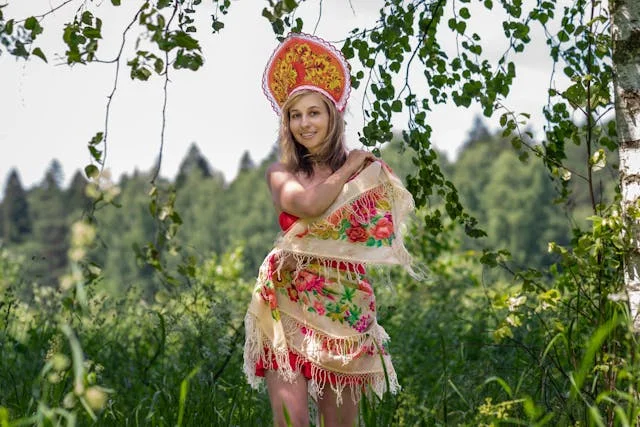
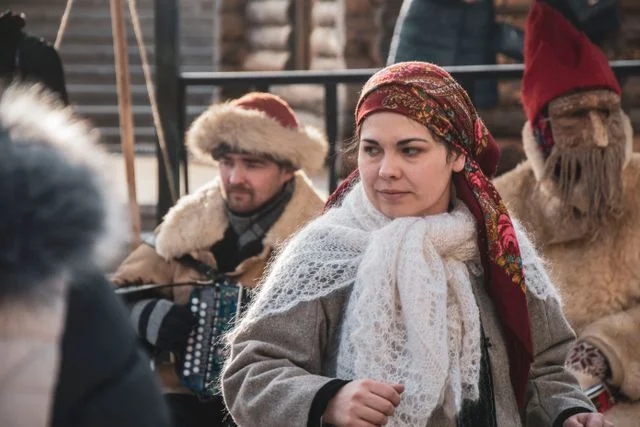
Head coverings in winter were non-negotiable for women. Married women wore the kokoshnik — the elaborate headdress most associated with Russian folk dress — but this was primarily a ceremonial piece for weddings and festivals, not daily winter wear. For everyday cold weather, women wrapped their heads in thick wool shawls called platok, folded diagonally and tied under the chin. By the 19th century, the Pavlovo Posad factory near Moscow had become the dominant producer of these shawls, and their floral-bordered wool platoky remain recognizable today. Understanding how the kokoshnik fits into the broader context of Russian clothing across different historical eras helps clarify which pieces were everyday dress and which were reserved for ceremonies.
Quick Note: The wool platok (head shawl) was far more common in daily winter life than the kokoshnik. When you see images of Russian women in elaborate headdresses, those are almost always festive or ceremonial photographs, not depictions of working dress.
What Russian Children Wore in Winter: Traditional Clothing for Kids
Russian children’s traditional winter clothing followed the adult system almost exactly, scaled down. Boys and girls both wore the sorochka as a base layer from infancy onward, with the practical difference that very young children’s garments were often cut from the worn-out clothing of parents — a textile recycling practice documented across rural Russia through the early 20th century. According to ethnographic records held at the Russian Museum of Ethnography in St. Petersburg, this practice was not purely economic. There was a folk belief that a child dressed in cloth cut from a parent’s garment would inherit some of that parent’s strength and protection.
By the age of five or six, boys were dressed in small versions of adult male winterwear: wool trousers, a belted sorochka, and a short zipun-style coat for outdoor play or work. Girls wore layered skirts with a wool dushegreya over the top. Footwear for children in winter was almost universally valenki — felted wool boots that could be pulled on over thick wool socks. Valenki are one of the most distinctly Russian winter inventions: they require no stitching, offer excellent insulation against ground cold, and have been in continuous production since at least the early 19th century. Soviet-era children in the 1950s wore essentially the same valenki that their great-grandparents had worn, often with rubber overshoes added to protect them from wet snow.
A note on the 1950s specifically: Soviet-era children’s traditional winter dress had simplified considerably from folk costume by that point, but the core cold-weather logic remained intact. State-produced wool coats with fur collars, knitted scarves, and valenki defined the look for most Soviet children through the mid-century period. Folk embroidery on children’s garments had largely disappeared from everyday dress by this point, surviving mainly in organized folk ensembles and museum collections rather than in actual use. If you are researching Russian children’s clothing for historical or costuming purposes, the distinction between pre-Soviet folk dress and mid-20th-century Soviet production clothing matters a great deal.
Footwear and Accessories That Completed the Russian Winter Look
The valenki deserve their own section because they represent one of the most effective cold-weather footwear solutions ever developed — and one that is still commercially produced and worn in Russia today. Brands like Kotofey (Russia) and specialty importers in the UK and US carry modern valenki, often in updated silhouettes with rubber soles added for urban use. Traditional valenki are made by wet-felting raw wool, compressing it under heat and pressure until it forms a rigid, seamless boot. A well-made pair provides insulation down to approximately −30°C without additional lining.
Mittens rather than gloves were standard winter accessories across Russia for both adults and children. The logic is sound: mittens keep fingers together, sharing body heat, which is significantly more effective in extreme cold than separated fingers in gloves. Wool mittens were often double-layered, with an inner knitted liner and an outer leather or thick wool shell. Embroidery on mittens was common in festive versions — geometric patterns in red and white thread appear across multiple regional traditions, from the Vologda area to the Urals.
The visual contrast between Russian and Korean winter layering traditions is worth noting for those exploring cold-climate traditional dress broadly. Where Russian winter dress prioritized bulk and insulation above all else, Korean traditional winter clothes used padded silk and cotton layering in a system that achieved similar insulation with a cleaner silhouette. Both solutions are elegant responses to cold-weather dressing — just built from completely different textile traditions.
Our take: The smartest thing about traditional Russian winter dress is not any individual garment — it is the principle that no single layer does all the work. The shuba gets all the attention, but the system underneath it is what actually kept people alive. If you are drawing on Russian winter clothing for a costume, a fashion editorial, or historical research, start with the layering logic, not the outer piece.
One honest limitation of this kind of article: traditional Russian clothing was extraordinarily regional. What a peasant woman in Tula Province wore in winter differed substantially from what her counterpart in Arkhangelsk or Siberia wore. This article describes the most widely documented forms, but it cannot capture every regional variant. For truly specific regional research, the Russian Museum of Ethnography’s published catalogs are the most reliable primary source available in English translation.
Frequently Asked Questions
What is the traditional winter outer coat worn in Russia called?
The most common traditional Russian winter outer coat is the shuba, a broad term for any heavily insulated coat, typically lined or made from sheepskin or fur. The tulup is a specific type of shuba — a long sheepskin coat with the wool turned inward — associated with peasants and coachmen. Wealthier Russians wore shubi lined with fox, sable, or beaver fur, often covered in embroidered or brocade fabric. The armyak and kaftan were additional outer coats worn by men, each suited to slightly different social contexts and levels of cold.
What did Russian men wear in winter traditionally?
Traditional winter traditional russian clothing male wardrobe consisted of a linen or wool sorochka (shirt) as a base layer, thick wool trousers, a belted sash at the waist, and one of several outer coats depending on class and region. Working men wore the zipun, a short collarless wool coat, or the longer armyak for travel. Wealthier men wore fitted kaftans with fur or embroidered trim. Fur hats — the ushanka or the shapka — covered the head and ears, and valenki (felted wool boots) protected the feet against ground cold.
What is the difference between a shuba and a tulup?
A shuba is a broad category that refers to any fur or heavily insulated Russian winter coat. A tulup is a specific type of shuba — a long, straight sheepskin coat made with the fleece facing inward to trap heat, and the leather exterior facing out. The tulup was a working-class garment, associated with long outdoor labor and travel. The word shuba, by contrast, could also describe a tailored fur-lined coat worn by nobility, so the two terms are not interchangeable even though a tulup is technically a kind of shuba.
What shoes did Russians wear in winter traditionally?
Valenki — seamless felted wool boots — were the standard cold-weather footwear across Russia for centuries and remain in use today. They are made by compressing wet wool under heat until it forms a rigid, insulating boot with no seams. In wet or slushy conditions, valenki were worn with rubber galoshes pulled over the top to keep the felt dry. Leather boots with wool lining were also worn by wealthier Russians, and bast-fiber shoes called lapti were common among peasants for milder weather, though not suitable for deep winter conditions.
How did Russian children’s traditional winter clothing differ from adult dress?
Russian children’s traditional winter clothing closely mirrored adult dress in construction and layering logic, scaled down to smaller sizes. Very young children were often dressed in garments cut from worn adult clothing, a practice with both economic and folk-belief origins. Boys wore small versions of adult male winterwear — wool trousers, belted sorochka, and a short coat — from around age five or six. Girls wore layered skirts and wool dushegreyy. Valenki were the near-universal winter footwear for children. By the Soviet era, state-produced wool coats with fur collars replaced folk costume, but valenki and layering logic persisted.
Is Russian winter clothing still worn today, and where can you buy it?
Several traditional Russian cold-weather pieces remain in active use. Valenki are produced commercially by brands including Kotofey in Russia and are available through specialty importers in the US and UK. Pavlovo Posad wool shawls — the floral-bordered platoky — are still manufactured and exported globally. Modern versions of the shuba exist as fashionable fur or faux-fur coats sold by Russian and international brands. For authentic folk costume pieces — embroidered sarafans, dushegreyy, or regional garments — specialist ethnographic shops in Moscow and St. Petersburg, as well as online platforms like Etsy, carry reproductions and occasionally original antique pieces.
Final Thoughts
Russian traditional winter clothing is one of the most functionally sophisticated cold-weather dress systems ever developed. It was not built by fashion designers — it was built by generations of people who died if they got it wrong. The layering logic, the insulating materials, the specific function of each garment from the sorochka outward to the shuba, all of it reflects accumulated practical knowledge refined over centuries of serious cold. That is what gives these garments their enduring interest — they solved a real problem, and they solved it well.
If you are researching Russian winter dress for any purpose — historical study, costume design, editorial fashion, or general cultural knowledge — the most useful next step is to look at the regional variation. The garments described here represent the most widely documented forms, but Russia is enormous, and the differences between a northern Arkhangelsk winter outfit and a southern Cossack winter outfit are substantial. Start with the core pieces of traditional Russian costume if you need the foundational vocabulary, then narrow into the regional specifics that matter for your purpose.




Leave feedback about this