

What Is Traditional Russian Clothing Called? Names & History
According to the State Historical Museum in Moscow, the earliest surviving examples of Russian folk dress date to the 17th century — yet the garments they preserve reflect a clothing tradition that had been developing for nearly a thousand years before that. Knowing what is traditional Russian clothing called is not simply a matter of naming a single outfit; it means understanding a layered system of garments, each with its own name, function, and deep regional meaning.
This article covers the key names, history, and styles of traditional Russian clothing for both men and women. You will learn what the specific garments are called, what they looked like, how they varied by region and social class, and how some of these pieces are influencing modern fashion today. Whether you are researching for a costume, a historical project, or pure cultural curiosity, you will find specific answers here — not vague descriptions.
Most articles on this topic either list garment names without context or give a surface-level history without explaining regional variation or male dress. This guide goes further: it names the actual traditional Russian clothing names, explains what distinguishes each piece, covers the male wardrobe in depth, and addresses how these garments have survived into modern design — gaps that most competitors skip entirely.
What Is Traditional Russian Clothing Called? The Core Garment Names
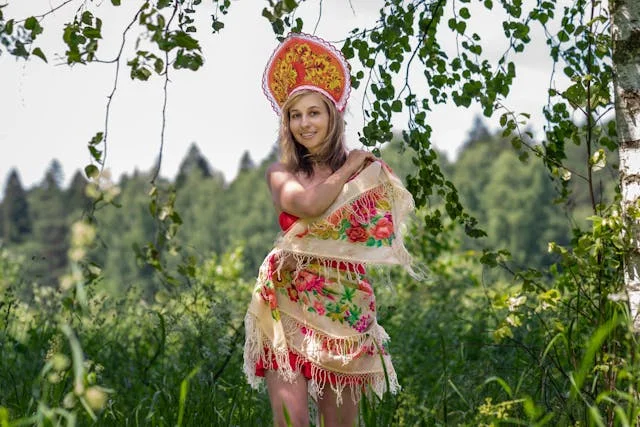
The most recognized name in traditional Russian clothing is the sarafan — a long, sleeveless or short-sleeved pinafore dress worn over a linen blouse called a rubakha. The sarafan is so closely associated with Russian folk dress that many people use it as a shorthand for the entire tradition. It was worn primarily by women and girls, and its cut, color, and embroidery pattern varied dramatically depending on the region and the occasion.
The rubakha — the linen undertunic — was actually the foundational garment for both men and women. Men wore it as an outer shirt, usually belted at the waist, while women wore it beneath the sarafan or the ponyova. The rubakha was almost always decorated with embroidery at the collar, cuffs, and hem, and those patterns carried specific regional and ritual meaning. In northern Russia, red thread embroidery on white linen was standard; in southern regions, the patterns became denser and more colorful.
The ponyova is a garment that many Western accounts overlook completely. It was a woolen wrap-skirt worn in southern and central Russia, distinct from the sarafan style dominant in the north. The ponyova consisted of two or three panels of checkered or striped wool fabric gathered at the waist, and it was traditionally worn only by married women — putting it on for the first time was part of coming-of-age and betrothal rituals. If you are asking what is the traditional clothing in Russia from a regional perspective, the answer is genuinely different depending on which part of Russia you are looking at.
Traditional Russian Clothing Names for Men: The Full Picture
The male wardrobe in traditional Russia is frequently under-explained, which is worth correcting. Men wore the rubakha as their primary visible garment — a long linen tunic that fell to mid-thigh or knee, worn loose or belted with a woven sash called a kushak. The cut of the collar was one of the key distinguishing features: the kosovorotka, meaning “side-buttoning collar,” was the classic Russian male shirt with a collar that opened to the left rather than straight down the center. This is probably the single most recognizable piece of Russian traditional clothing for men, and it remained in everyday use well into the early 20th century.
Over the rubakha, men wore porty — loose linen trousers tucked into knee-length boots called sapogi. Wealthier men wore leather sapogi; peasant men more commonly wore bast-fiber shoes called lapti, woven from birch bark. In winter, men layered a sheepskin coat called a tulup over everything — a practical, heavy garment that was essentially a long sheepskin with the fleece turned inward. For you to understand what is Russia’s traditional clothing for men in a single sentence: it was a system of layered linen and wool, built around the kosovorotka shirt and adapted heavily for the cold.
According to the Russian Museum in St. Petersburg, the kosovorotka experienced a significant cultural revival in the late 19th century when Russian intelligentsia and artists began wearing it as a deliberate statement of national identity, separate from the Western European fashions that dominated elite Russian society at the time. Tolstoy famously wore one as part of his embrace of peasant simplicity.
Traditional Russian Clothing History: How the Garments Developed
Russian traditional dress developed over roughly a thousand years, shaped by climate, trade routes, and the social structure of rural peasant life. The earliest Slavic garments were simple linen tunics, and the basic silhouette changed remarkably little between the 10th and 18th centuries. What did change was the elaboration of embroidery, the use of dyes, and the influence of neighboring cultures — particularly Tatar, Scandinavian, and Byzantine textile traditions.
The 18th century was a dramatic turning point. When Peter the Great forced the Russian nobility to adopt Western European dress in 1701, traditional Russian clothing became explicitly associated with the peasant class. This divide between court fashion and folk dress lasted nearly two centuries. Paradoxically, it actually preserved traditional garments more intact among the rural population, because peasants had no reason to abandon what worked. The sarafan, kokoshnik, and kosovorotka that survive in museums today often date from this period of enforced bifurcation.
The 19th century saw a deliberate Romantic revival of folk dress as part of Russian national identity movements. Artists like Viktor Vasnetsov painted subjects in traditional garments, and the Imperial family occasionally wore folk-inspired dress for state portraits — you can see this in the famous 1903 Imperial Costume Ball at the Winter Palace, where attendees dressed in historically inspired Russian garments. If you want to explore how this royalty-level clothing developed era by era, the history of royalty traditional Russian clothing by era covers that specific evolution in depth.
The Kokoshnik and Other Traditional Russian Accessories
No account of traditional Russian clothing is complete without addressing the kokoshnik — the distinctive headdress that has become one of the most internationally recognized symbols of Russian folk dress. The kokoshnik was a stiffened headpiece worn by married women, typically made from fabric stretched over a cardboard or birch-bark frame and decorated with embroidery, pearls, beads, or gold thread. The shape varied dramatically by region: some were tall and crescent-shaped, others were flat and square, others had a rounded fan shape.
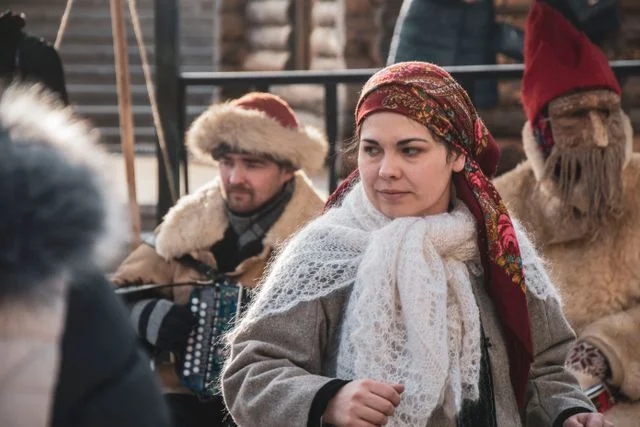
The kokoshnik was not everyday wear for most women — it was reserved for festivals, weddings, and special occasions. Daily hair covering for married women was more commonly a simpler cloth called a povoinik or a platok (headscarf). Understanding this distinction matters because popular images of Russian traditional dress tend to feature the most elaborate versions, giving a misleading impression that festive dress was typical dress.
Other key accessories included the perednik (apron), which was worn over the sarafan and often heavily embroidered, and the opaska or chest piece, which was a decorative front panel attached to the rubakha. Footwear ranged from the bast lapti of ordinary peasants to embroidered leather boots for wealthier women. For a deeper look at how these individual pieces came together as an outfit, the guide to what makes a traditional Russian outfit covers the full composition in detail.
Quick Note: Regional variation in Russian traditional dress is significant enough that two garments from different provinces of the same era can look almost entirely different. The sarafan-and-kokoshnik combination associated with northern Russia is not the same as the ponyova-based dress of southern regions. Both are authentically Russian — they simply reflect different geographic and cultural conditions.
Modern Russian Traditional Clothing: What Survived and What Changed
Traditional Russian garments did not disappear with modernization — they were absorbed, adapted, and occasionally revived. The Soviet era had a complex relationship with folk dress: on one hand, the Bolsheviks associated traditional peasant clothing with backwardness; on the other, folk art and craft were promoted as expressions of proletarian culture, and embroidery traditions were kept alive through state craft enterprises and performing arts ensembles.
Today, modernized traditional Russian clothing appears in several distinct contexts. Folk dance and theater ensembles still use historically accurate reconstructions. High-end Russian fashion houses, including Ulyana Sergeenko (Moscow) and YANINA Couture (both with international clientele), have drawn directly from folk dress elements — embroidery motifs, sarafan silhouettes, and kokoshnik-inspired headpieces appear in their collections. This is not appropriation; it is continuation of a tradition that has always adapted.
For everyday wear, the most visible survival is the embroidered linen shirt. Contemporary Russian designers sell modern versions of the kosovorotka and rubakha-style tops to customers who want to connect with the aesthetic without wearing full folk costume. This is where the line between modern Russian traditional clothing and contemporary ethno-fashion blurs — and where, frankly, it gets interesting for anyone interested in how folk dress influences current style.
Our take: If you are interested in incorporating traditional Russian clothing elements into a modern wardrobe, the most wearable approach is through embroidered linen pieces rather than full folk costume. A rubakha-inspired linen shirt with chest embroidery is genuinely versatile and connects directly to centuries of Russian textile craft. Full sarafan and kokoshnik combinations are better suited to costume or performance contexts — wearing them casually tends to read as costume rather than culture-informed style, which rarely lands well.
It is worth acknowledging one limitation here: if your goal is sourcing authentic Russian folk dress, supply outside Russia is genuinely limited. Most embroidered pieces available on international platforms vary considerably in authenticity and craft quality. Russian craft markets and specialist vendors — Palekh-style craft workshops and regional artisan cooperatives — remain the most reliable source for genuine pieces, but importing them involves both cost and lead time. This is a real constraint that most guides on this topic ignore. You can see how Russian traditional winter clothing solves some of these practical sourcing questions for cold-weather pieces specifically.
For those interested in how other Eastern European folk traditions compare — particularly in terms of garment structure and regional variation — the coverage of traditional Polish clothing and ethno-fashion offers a useful parallel, since Polish and Russian folk dress share some structural similarities while diverging sharply in embroidery style and headwear.
Frequently Asked Questions
What is traditional Russian clothing called for women?
The main pieces of traditional Russian women’s clothing are the sarafan (a long sleeveless dress), the rubakha (a linen blouse worn underneath), the ponyova (a wrap-skirt used in southern regions), and the kokoshnik (a stiffened headdress for married women). The sarafan-and-rubakha combination is the most internationally recognized form, though it was primarily northern and central Russian. In southern Russia, the ponyova replaced the sarafan and gave women’s dress a completely different silhouette. Accessories such as the perednik apron and embroidered platok headscarf completed most everyday ensembles.
What is Russian traditional clothing called for men?
The core of men’s traditional Russian clothing is the kosovorotka — a linen shirt with a side-fastening collar that opens to the left. It was worn over loose linen trousers called porty, belted with a woven sash called a kushak. Men also wore bast shoes called lapti or leather boots called sapogi, depending on their economic status. In cold weather, the tulup — a heavy sheepskin coat — was essential outerwear. The kosovorotka is the single garment most closely identified with the Russian male folk wardrobe and remained in common use until the early Soviet period.
Is there a difference between Russian folk dress by region?
Yes, and the difference is significant. Northern and central Russia developed the sarafan tradition, characterized by tall kokoshnik headdresses and heavy embroidery on white or red linen. Southern Russia used the ponyova wrap-skirt instead of the sarafan, with different headdress styles and denser polychrome embroidery. Siberian and Cossack dress incorporated additional influences from Turkic and Central Asian neighbors. Even within these broad regions, each district often had distinctive embroidery patterns that functioned almost like a regional identity marker — experienced textile scholars can identify a garment’s origin within a fairly narrow geographic area based on embroidery alone.
How to draw Russia traditional clothes accurately?
For accurate illustration of Russian traditional dress, the key reference sources are the collections of the Russian Museum in St. Petersburg and the State Historical Museum in Moscow, both of which maintain extensive photographic archives online. For women’s dress, focus on the silhouette differences between the northern sarafan (long, A-line, usually dark blue or red) and the southern ponyova (wrap-skirt, more checkered). Men’s kosovorotka shirts have a distinctive off-center collar opening to the left, which is an easy detail to get wrong. Embroidery placement is precise — for rubakha shirts, it appears at the hem, cuffs, and collar, never randomly across the body.
What materials were used in traditional Russian clothing?
Linen was the primary fabric for everyday garments — both the rubakha and the underlayers of most women’s dress were linen. Wool was used for the ponyova, winter skirts, and outer coats. Wealthier Russians used silk for festive dress and brocade for ceremonial pieces, much of which was imported via trade routes with Persia and China. Fur was extensively used for trim and full coats — sable, fox, and sheepskin were all common depending on social class. Cotton became more widely available in the 19th century but was considered inferior to linen for folk dress purposes and was mostly adopted in urban contexts first.
Is traditional Russian clothing still worn today?
Everyday use is rare outside of ceremonial contexts, but the tradition is genuinely alive in specific forms. Folk dance ensembles, theater productions, and cultural festivals are the most common settings for full traditional dress. In Russian fashion, elements of folk dress — particularly embroidery motifs and sarafan silhouettes — appear regularly in the work of designers like Ulyana Sergeenko and YANINA Couture. There is also a growing domestic market in Russia for embroidered linen shirts as casual-formal wear, particularly among people interested in Slavic cultural identity. The kokoshnik has had a somewhat unexpected international moment as a bridal accessory, appearing in editorial fashion shoots in the UK and US over the past decade.
Final Thoughts
What is traditional Russian clothing called? The honest answer is: several things, depending on region, gender, and occasion. The sarafan and kokoshnik are the most recognized pieces internationally, but the full vocabulary includes the rubakha, ponyova, kosovorotka, kushak, tulup, and a range of regional accessories that vary as much as Russian geography does. Understanding the naming system means understanding that Russian folk dress was never one uniform national costume — it was a family of related garment traditions that shared structural logic but differed dramatically in detail.
If you want to go further, start with the difference between northern and southern women’s dress — that single distinction unlocks the most common confusion people have when they try to understand Russian traditional clothing information from a single source. For those specifically interested in how this tradition played out at the royal and imperial level, the article on royalty traditional Russian clothing by era is the logical next step.




Leave feedback about this